

NCERT Solutions for Class 12 Maths Chapter 6 Application of Derivatives
NCERT Solutions for Class 12 Maths Chapter 6 Application of Derivatives helps students understand tangents, maxima-minima, and rate of change concepts clearly. Moreover, structured solutions improve accuracy and confidence. Therefore, regular practice strengthens conceptual clarity and prepares students for board exams with better performance.
Download Application of Derivatives Study Material
Students can access NCERT Solutions for Class 12 Maths Chapter 6 Application of Derivatives PDF for structured revision and offline learning. Moreover, organized study material improves accuracy and confidence. Therefore, consistent practice helps students solve derivative problems easily and perform better in board examinations.
NCERT Solutions for Class 12 Maths Chapter 6 Application of Derivatives
NCERT Solutions for Class 12 Maths Chapter 6 Application of Derivatives improves conceptual clarity. Moreover, structured practice builds confidence. Therefore, students solve derivative problems faster and perform better in board exams.
NCERT Exercise – 6.1
Evaluate the determinants in Exercises 1 and 2.
-
Find the rate of change of the area of a circle with respect to its radius $r$ when
(a) $r = 3$ cm
(b) $r = 4$ cmSOLUTION
Let $A = \pi {r^2}$ …(1) (where $A$ denotes the area of the circle when its radius is $r$). Differentiating (1), w.r.t. $r$, we get $\cfrac{{dA}}{{dr}} = \pi (2r) = 2\pi r$.
(a) ${\left( {\cfrac{{dA}}{{dr}}} \right)_{r = 3{\rm{cm}}}} = 2\pi (3){\rm{cm}} = 6\pi {\rm{c}}{{\rm{m}}^{\rm{2}}}{\rm{/cm}}$
(b) ${\left( {\cfrac{{dA}}{{dr}}} \right)_{r = 4{\rm{cm}}}} = 2\pi (4)cm = 8\pi {\rm{c}}{{\rm{m}}^{\rm{2}}}{\rm{/cm}}$
-
The volume of a cube is increasing at the rate of $8{\rm{c}}{{\rm{m}}^{\rm{3}}}{\rm{/s}}$. How fast is the surface area increasing when the length of an edge is $12{\rm{ cm}}$?
SOLUTION
Let at any instant of time $t$, the edge of the cube be $x$, surface area be $S$ and the volume be $y$ then $V = {x^3}$ and $S = 6{x^2}$ …(i). Differentiating (i) w.r.t. $t$, we get $\Rightarrow \cfrac{{dV}}{{dt}} = 3{x^2}\cfrac{{dx}}{{dt}}$ …(ii) and $\cfrac{{dS}}{{dt}} = 6\left( {2x} \right)\cfrac{{dx}}{{dt}}$ …(iii).
$\cfrac{{dV}}{{dt}} = 8{\rm{c}}{{\rm{m}}^{\rm{3}}}{\rm{/sec}}$ (Given) $\Rightarrow 3{x^2}\cfrac{{dx}}{{dt}} = 8{\rm{c}}{{\rm{m}}^{\rm{3}}}{\rm{/sec}}$ (using (ii)). $\Rightarrow 3{\left( {12{\rm{cm}}} \right)^2}\cfrac{{dx}}{{dt}} = 8{\rm{c}}{{\rm{m}}^{\rm{3}}}{\rm{/sec}} \Rightarrow \cfrac{{dx}}{{dt}} = \cfrac{8}{{432}}{\rm{cm/sec}} = \cfrac{1}{{54}}{\rm{cm/sec}}$.
Substituting this value of $\cfrac{{dx}}{{dt}}$ in (iii), we get $\cfrac{{dS}}{{dt}} = 12\left( {12{\rm{cm}}} \right)\left( {\cfrac{1}{{54}}{\rm{cm/sec}}} \right) = \cfrac{8}{3}{\rm{c}}{{\rm{m}}^{\rm{2}}}{\rm{/sec}}$. $\therefore$ Rate of increase of surface area $ = \cfrac{8}{3}{\rm{c}}{{\rm{m}}^{\rm{2}}}{\rm{/sec}}$.
-
The radius of a circle is increasing uniformly at the rate of $3{\rm{cm/s}}$. Find the rate at which the area of the circle is increasing when the radius is $10{\rm{ cm}}$.
SOLUTION
Let at any instant of time $t$, the radius of the circle be $r$ and its area be $A$. Then, $A = \pi {r^2}$. $\Rightarrow \cfrac{{dA}}{{dt}} = \pi (2r)\cfrac{{dr}}{{dt}}$ and ${\left( {\cfrac{{dA}}{{dt}}} \right)_{r = 10{\rm{cm}}}} = 2\pi (10{\rm{cm}})(3{\rm{cm/sec)}} = 60\pi {\rm{c}}{{\rm{m}}^{\rm{2}}}{\rm{/sec}}$. $\therefore$ Rate of increase of area of the circle $ = 60\pi {\rm{c}}{{\rm{m}}^{\rm{2}}}{\rm{/sec}}$.
-
An edge of a variable cube is increasing at the rate of $3{\rm{cm/s}}$. How fast is the volume of the cube increasing when the edge is $10{\rm{ cm}}$ long?
SOLUTION
Let at any instant of time $t$, the edge of the cube be $x$ and its volume be $V$ then $V = {x^3}$ …(i). Differentiating (i) w.r.t. $t$, we get $\Rightarrow \cfrac{{dV}}{{dt}} = 3{x^2}\cfrac{{dx}}{{dt}} = 3{{\rm{(10cm)}}^{\rm{2}}}\left( {{\rm{3cm/sec}}} \right) = 900{\rm{c}}{{\rm{m}}^{\rm{3}}}{\rm{/sec}}$. $\therefore$ Rate of increase of volume of the cube is $900{\rm{c}}{{\rm{m}}^{\rm{3}}}{\rm{/sec}}$.
-
A stone is dropped into a quiet lake and waves move in circles at the speed of $5{\rm{cm/s}}$. At the instant when the radius of the circular wave is $8{\rm{ cm}}$, how fast is the enclosed area increasing?
SOLUTION
Let at any instant of time $t$, the radius of the circular wave be $r$ and the area enclosed be $A$, then $A = \pi {r^2}$ …(i). Differentiating (i) w.r.t. $t$, we have $\Rightarrow \cfrac{{dA}}{{dt}} = \pi (2r)\cfrac{{dr}}{{dt}} = 2\pi (8cm)(5{\rm{cm/sec}}) = 80\pi {\rm{c}}{{\rm{m}}^{\rm{2}}}{\rm{/sec}}$. $\therefore$ Rate of increase of enclosed area $ = 80\pi {\rm{c}}{{\rm{m}}^{\rm{2}}}{\rm{/sec}}$.
-
The radius of a circle is increasing at the rate of $0.7{\rm{cm/s}}$. What is the rate of increase of its circumference?
SOLUTION
Let at any instant of time $t$, the radius of the circle be $r$ and its circumference be $C$, then $C = 2\pi r$ …(i). Differentiating (i) w.r.t. $t$, we get $\cfrac{{dC}}{{dt}} = 2\pi \cfrac{{dr}}{{dt}} = 2\pi (0.7){\rm{cm/sec}} = (1.4\pi ){\rm{cm/sec}}$. Hence, the rate of increase of circumference $ = (1.4\pi ){\rm{cm/sec}}$.
-
The length $x$ of a rectangle is decreasing at the rate of $5{\rm{ cm/minute}}$ and the width $y$ is increasing at the rate of $4{\rm{ cm/minute}}$. When $x = 8{\rm{cm}}$ and $y = 6{\rm{cm}}$, find the rates of change of (a) perimeter, and (b) the area of the rectangle.
SOLUTION
Let at any instant of time $t$, length of rectangle be $x$, breadth be $y$, the perimeter $P$ and the area be $A$, then We have, $\cfrac{{dx}}{{dt}} = – 5{\rm{cm/min}}$ and $\cfrac{{dy}}{{dt}} = 4{\rm{cm/min}}$.
(a) $P = 2(x + y)$ …(i). Differentiating (i) w.r.t. $t$, we get $\cfrac{{dP}}{{dt}} = 2\left( {\cfrac{{dx}}{{dt}} + \cfrac{{dy}}{{dt}}} \right) = 2( – 5 + 4){\rm{cm/min}} = – 2{\rm{cm/min}}$. $\therefore$ Perimeter of the rectangle is decreasing at the rate of $2{\rm{cm/min}}$.
(b) $A = xy$ …(ii). Differentiating (ii) w.r.t. $t$, we get $\cfrac{{dA}}{{dt}} = x\cfrac{{dy}}{{dt}} + y\cfrac{{dx}}{{dt}} = \left( {8{\rm{cm}}} \right)\left( {4{\rm{cm/min}}} \right) + \left( {6{\rm{cm}}} \right)\left( { – 5{\rm{cm/min}}} \right) = 2{\rm{c}}{{\rm{m}}^{\rm{2}}}{\rm{/min}}$. $\therefore$ Area of the rectangle is increasing at the rate of $2{\rm{c}}{{\rm{m}}^{\rm{2}}}{\rm{/min}}$.
-
A balloon, which always remains spherical on inflation, is being inflated by pumping in $900$ cubic centimetres of gas per second. Find the rate at which the radius of the balloon increases when the radius is $15$ cm.
SOLUTION
Let at any instant of time $t$, the radius of the balloon be $r$ and its volume be $V$, then $V = \cfrac{4}{3}\pi {r^3}$ …(i). Differentiating (i) w.r.t. $t$, we get $\cfrac{{dV}}{{dt}} = \left( {\cfrac{4}{3}\pi } \right)\left( {3{r^2}\cfrac{{dr}}{{dt}}} \right)$. $\Rightarrow 900{\rm{c}}{{\rm{m}}^{\rm{3}}}{\rm{/sec}} = \left( {\cfrac{4}{3}\pi } \right)\left\{ {3{{(15cm)}^2}\cfrac{{dr}}{{dt}}} \right\} \Rightarrow \cfrac{{dr}}{{dt}} = \cfrac{{900}}{{4\pi \times {{\left( {15} \right)}^2}}}{\rm{cm/sec}} = \cfrac{1}{\pi }{\rm{cm/sec}}$. $\therefore$ Rate of increase of the radius of the balloon $ = \cfrac{1}{\pi }{\rm{cm/sec}}$.
-
A balloon, which always remains spherical has a variable radius. Find the rate at which its volume is increasing with the radius when the later is 10 cm.
SOLUTION
Let at any instant of time, the radius of the balloon be $r$ and its volume be $V$, then $V = \cfrac{4}{3}\pi {r^3}$ …(i). Differentiating (i) w.r.t. $r$, we get $\cfrac{{dV}}{{dr}} = \left( {\cfrac{4}{3}\pi } \right)3{r^2} = 4\pi {r^2} = 4\pi {\left( {10{\rm{cm}}} \right)^2} = 400\pi {\rm{c}}{{\rm{m}}^3}$. Rate of increase of volume with respect to change in radius $ = 400\pi {\rm{c}}{{\rm{m}}^{\rm{3}}}{\rm{/cm}}$.
-
A ladder $5$m long is leaning against a wall. The bottom of the ladder is pulled along the ground, away from the wall, at the rate of $2{\rm{cm/s}}$. How fast is its height on the wall decreasing when the foot of the ladder is $4{\rm{m}}$ away from the wall?
SOLUTION
If the foot of the ladder is at a distance $x$ from the wall and the top is at a vertical height of $y$ at any instant of time $t$, then ${\left( 5 \right)^2} = {x^2} + {y^2}$ …(i). Differentiating (i) w.r.t. $t$, we have $\Rightarrow \cfrac{d}{{dt}}\left( {25} \right) = 2x\cfrac{{dx}}{{dt}} + 2y\cfrac{{dy}}{{dt}}$ …(ii). We have $\cfrac{{dx}}{{dt}} = 0.02{\rm{m/sec}}$, $x = 4{\rm{m}}\,\,{\rm{and}}\,\,y = \sqrt {5 – {4^2}} {\rm{m}} = 3{\rm{m}}$. Hence, from (ii) $0 = 2 \times 4{\rm{m}} \times 0.02{\rm{m/sec}} + 2 \times 3{\rm{m}}\cfrac{{dy}}{{dt}} \Rightarrow \cfrac{{dy}}{{dt}} = – \cfrac{{0.16}}{6}{\rm{m/sec}}$. $\therefore$ Rate of decrease of height of the ladder on the wall $ = \cfrac{{16}}{{600}}{\rm{m/sec}} = \cfrac{{1600}}{{600}}{\rm{cm/sec}} = \cfrac{8}{3}{\rm{cm/sec}}$.
-
A particle moves along the curve $6y = {x^3} + 2$. Find the points on the curve at which the $y-$ coordinate is changing $8$ times as the $x-$coordinate.
SOLUTION
We have the curve, $6y = {x^3} + 2$ …(i) and $\cfrac{{dy}}{{dt}} = 8\cfrac{{dx}}{{dt}}$. Differentiating (i) w.r.t. $t$, we obtain $6\cfrac{{dy}}{{dt}} = 3{x^2}\cfrac{{dx}}{{dt}} \Rightarrow 6 \times \cfrac{{8dx}}{{dt}} = 3{x^2}\cfrac{{dx}}{{dt}} \Rightarrow \cfrac{{dx}}{{dt}}\left( {48 – 3{x^2}} \right) = 0$. $\cfrac{{dx}}{{dt}}$ cannot equal to zero $\therefore$ $48 – 3{x^2} = 0 \Rightarrow x = \pm 4$. When $x = 4 \Rightarrow 6y = {4^3} + 2 \Rightarrow y = \cfrac{{66}}{6} = 11$. When $x = – 4 \Rightarrow 6y = {\left( { – 4} \right)^3} + 2 \Rightarrow y = \cfrac{{ – 62}}{6} = \cfrac{{ – 31}}{3}$. Hence, the required points are $\left( {4,11} \right)$ and $\left( { – 4,\cfrac{{ – 31}}{3}} \right)$.
-
The radius of an air bubble is increasing at the rate of $\cfrac{1}{2}{\rm{cm/s}}$. At what rate is the volume of the bubble increasing when the radius is $1{\rm{cm}}$?
SOLUTION
Let at any instant of time $t$, the radius of the bubble be $r$ and its volume be $V$, then $V = \cfrac{4}{3}\pi {r^3}$ …(i). Differentiating (i), w.r.t. $t$, we get $\cfrac{{dV}}{{dt}} = \left( {\cfrac{4}{3}\pi } \right)\left( {3{r^2}\cfrac{{dr}}{{dt}}} \right) = 4\pi {r^2}\cfrac{{dr}}{{dt}} = 4\pi {\left( {1{\rm{cm}}} \right)^2}\left( {\cfrac{1}{2}{\rm{cm/sec}}} \right) = 2\pi {\rm{c}}{{\rm{m}}^{\rm{3}}}{\rm{/sec}}$. Hence, the rate of increase of the volume of the bubble $ = 2\pi {\rm{c}}{{\rm{m}}^{\rm{3}}}{\rm{/sec}}$.
-
A balloon, which always remains spherical, has a variable diameter $\cfrac{3}{2}(2x + 1)$. Find the rate of change of its volume with respect to $x$.
SOLUTION
Diameter of the balloon, $d = \cfrac{3}{2}(2x + 1)$. $\therefore$ Radius of the balloon, $r = \cfrac{d}{2} = \cfrac{1}{2}\left\{ {\cfrac{3}{2}(2x + 1)} \right\} = \cfrac{3}{4}(2x + 1)$. So, the volume $V$ of the balloon $V = \cfrac{4}{3}\pi {\left( {{\rm{radius}}} \right)^3} = \cfrac{4}{3}\pi {\left\{ {\cfrac{3}{4}\left( {2x + 1} \right)} \right\}^3} = \cfrac{{9\pi }}{{16}}{(2x + 1)^3}$ …(i). Differentiating (i) w.r.t. $x$, we get $\cfrac{{dV}}{{dx}} = \cfrac{{9\pi }}{{16}} \times 3{(2x + 1)^2} \times 2 = \cfrac{{27\pi }}{8}{(2x + 1)^2}$.
-
Sand is pouring from a pipe at the rate of $12{\rm{c}}{{\rm{m}}^{\rm{3}}}{\rm{/s}}$. The falling sand forms a cone on the ground in such a way that the height of the cone is always one-sixth of the radius of the base. How fast is the height of the sand cone increasing when the height is $4{\rm{ cm}}$?
SOLUTION
Let at any instant of time $t$, the radius of the base of the cone be $r$, its height be $h$ and the volume of the sand cone be $V$, then $h = \cfrac{1}{6}r \Rightarrow r = 6h$ and $V = \cfrac{1}{3}\pi {r^2}h = \cfrac{1}{3}\pi {(6h)^2}h = 12\pi {h^3}$ …(i). Differentiating (i) w.r.t. $t$, we get $\cfrac{{dV}}{{dt}} = \left( {12\pi } \right)\left( {3{h^2}\cfrac{{dh}}{{dt}}} \right)$. $\Rightarrow 12{\rm{c}}{{\rm{m}}^{\rm{3}}}{\rm{/sec}} = 36\pi {\left( {4{\rm{cm}}} \right)^2}\cfrac{{dh}}{{dt}} \Rightarrow \cfrac{{dh}}{{dt}} = \cfrac{{12}}{{36\pi \times 16}}{\rm{cm/sec}} = \cfrac{1}{{48\pi }}{\rm{cm/sec}}$. $\therefore$ Rate of increase of the height of the sand cone $ = \cfrac{1}{{48\pi }}$ cm/sec.
-
The total cost $C(x)$ in rupees associated with the production of $x$ units of an item is given by $C(x) = 0.007{x^3} – 0.003{x^2} + 15x + 4000$. Find the marginal cost when $17$ units are produced.
SOLUTION
We have, $C(x) = 0.007{x^3} – 0.003{x^2} + 15x + 4000$ …(i). Differentiating (i) w.r.t. $x$, we get Marginal cost $ = \cfrac{{dC}}{{dx}} = 0.007 \times 3{x^2} – 0.003 \times 2x + 15 + 0$. $\therefore$ Marginal cost when 17 units are produced $ = Rs20.967$.
-
The total revenue in Rupees received from the sale of $x$ units of a product is given by $R(x) = 13{x^2} + 2x + 15$. Find the marginal revenue when $x = 7$.
SOLUTION
We have, $R(x) = 13{x^2} + 26x + 15$ …(i). Differentiating (i) w.r.t. $x$, we have. Marginal revenue $ = \cfrac{{dR}}{{dx}} = 13 \times 2x + 26 = 26x + 26$. $\therefore$ ${\left( {\cfrac{{dR}}{{dx}}} \right)_{x = 7}} = 26 \times 7 + 26 = 208$. $\Rightarrow$ Marginal revenue (when $x = 7$) $ = Rs208$.
Choose the correct answer in the Exercises 17 and 18.
-
The rate of change of the area of a circle with respect to its radius $r$ at $r = 6$ cm is
(A) $10\pi$ (B) $12\pi$ (C) $8\pi$ (D) $11\pi$SOLUTION
(B) If $A$ is the area of the circle corresponding to radius $r$, then $A = \pi {r^2}$ …(i). Differentiating (i) w.r.t. $r$, we get $\cfrac{{dA}}{{dr}} = 2\pi r$. $\therefore$ ${\left( {\cfrac{{dA}}{{dr}}} \right)_{r = 6{\rm{cm}}}} = 2\pi \left( {6{\rm{cm}}} \right) = 12\pi {\rm{cm}}$.
-
The total revenue in Rupees received from the sale of $x$ units of a product is given by $R\left( x \right) = 3{x^2} + 36x + 5$. The marginal revenue, when $x = 15$ is
(A) $116$ (B) $96$ (C) $90$ (D) $126$SOLUTION
(D) We have, $R(x) = 3{x^2} + 36x + 5$ …(i). Differentiating (i) w.r.t. $x$, we get, marginal revenue $\cfrac{{dR}}{{dx}} = \cfrac{d}{{dx}}(3{x^2} + 36x + 5) = 6x + 36$. $ = {\left( {\cfrac{{dR}}{{dx}}} \right)_{x = 15}} = 6 \times 15 + 36 = 126$.
NCERT Exercise – 6.2
-
Show that the function given by $f(x) = 3x + 17$ is strictly increasing on $R$.
SOLUTION
We have, $f(x) = 3x + 17$ …(i). $f(x)$ being a polynomial function, is continuous and derivable on $R$. Differentiating (i), w.r.t. $x$, we get $f'(x) = 3 > 0 \ \forall x \in R$. $\Rightarrow f$ is strictly increasing on $R$.
-
Show that the function given by $f\left( x \right) = {e^{2x}}$ is strictly increasing on $R$.
SOLUTION
We have, $f(x) = {e^{2x}}$ …(i). $f(x)$ being an exponential function, is continuous and derivable on $R$. Differentiating (i) w.r.t. $x$, we get $f'(x) = {e^{2x}} \cdot 2 = 2e^{2x} > 0$ for all $x \in R$. $\Rightarrow f$ is strictly increasing on $R$.
-
Show that the function given by $f\left( x \right) = \sin x$ is
(a) strictly increasing in $\left( {0,\cfrac{\pi }{2}} \right)$
(b) strictly decreasing in $\left( {\cfrac{\pi }{2},\;\pi } \right)$
(c) neither increasing nor decreasing in $\left( {0,\pi } \right)$SOLUTION
We have, $f(x) = \sin x$ …(i) which is continuous and derivable on $R$. Differentiating (i) w.r.t. $x$, we get $f'(x) = \cos x$.
(a) For all $x \in \left( {0,\cfrac{\pi }{2}} \right), \cos x > 0 \Rightarrow f'(x) > 0$. Therefore, $f(x) = \sin x$ is strictly increasing on $\left( {0,\cfrac{\pi }{2}} \right)$.
(b) For all $x \in \left( {\cfrac{\pi }{2},\pi } \right), \cos x < 0 \Rightarrow f'(x) < 0$. Therefore $f(x) = \sin x$ is strictly decreasing on $\left( {\cfrac{\pi }{2},\pi } \right)$.
(c) From parts (a) and (b), we conclude that $f\left( x \right) = \sin x$ is neither increasing nor decreasing on $(0,\;\pi )$.
-
Find the intervals in which the function $f$ given by $f(x) = 2{x^2} – 3x$ is
(a) strictly increasing
(b) strictly decreasingSOLUTION
We have, $f(x) = 2x^2 – 3x$ …(i). $f(x)$ is a polynomial function. Hence, $f(x)$ is continuous and derivable on $R$. Differentiating (i) w.r.t. $x$, we get $f'(x) = 4x – 3$.
(a) For strictly increasing, $f'(x) > 0 \Rightarrow 4x – 3 > 0 \Rightarrow x > \cfrac{3}{4}$. $\therefore$ $f$ is strictly increasing on $\left( {\cfrac{3}{4},\infty } \right)$.
(b) For strictly decreasing, $f'(x) < 0 \Rightarrow 4x - 3 < 0 \Rightarrow x < \cfrac{3}{4}$. $\therefore$ $f$ is strictly decreasing on $\left( { - \infty ,\;\cfrac{3}{4}} \right)$.
-
Find the intervals in which the function $f$ given by $f(x) = 2{x^3} – 3{x^2} – 36x + 7$ is
(a) strictly increasing
(b) strictly decreasingSOLUTION
We have, $f(x) = 2{x^3} – 3{x^2} – 36x + 7$ …(i). $f(x)$ is a polynomial function. Hence, $f\left( x \right)$ is continuous and derivable on $R$. Differentiating (i) w.r.t. $x$, we get $f'(x) = 6{x^2} – 6x – 36 = 6({x^2} – x – 6) = 6(x – 3)(x + 2)$.
(a) For increasing, $f'(x) > 0 \Rightarrow 6(x – 3)(x + 2) > 0 \Rightarrow (x – 3)(x – (-2)) > 0 \Rightarrow x < -2$ or $x > 3$. $\therefore$ $f$ is strictly increasing on $(- \infty, -2) \cup (3, \infty)$.
(b) For decreasing, $f'(x) < 0 \Rightarrow 6(x - 3)(x + 2) < 0 \Rightarrow (x - 3)(x - (-2)) < 0 \Rightarrow -2 < x < 3$. $\therefore$ $f$ is strictly decreasing on $(-2, 3)$.
-
Find the intervals in which the following functions are strictly increasing or decreasing:
(a) ${x^2} + 2x – 5$
(b) $10 – 6x – 2{x^2}$
(c) $-2{x^3} – 9{x^2} – 12x + 1$
(d) $6 – 9x – {x^2}$
(e) ${\left( {x + 1} \right)^3}{\left( {x – 3} \right)^3}$SOLUTION
(a) We have, $f(x) = {x^2} + 2x – 5$ …(i). $f(x)$ being a polynomial, is continuous and derivable on $R$. Differentiating (i), w.r.t. $x$, we get, $f'(x) = 2x + 2$. For increasing, $f'(x) > 0 \Rightarrow 2x + 2 > 0 \Rightarrow x > -1$. For decreasing, $f'(x) < 0 \Rightarrow 2x + 2 < 0 \Rightarrow x < -1$. $\therefore$ $f(x)$ is strictly increasing for $x > -1$ and strictly decreasing for $x < -1$.
(b) We have, $f(x) = 10 – 6x – 2{x^2}$ …(i). $f(x)$ being a polynomial, is continuous and derivable on $R$. Differentiating (i) w.r.t. $x$, we get $f'(x) = -6 – 4x$. For increasing, $f'(x) > 0 \Rightarrow -6 – 4x > 0 \Rightarrow -4x > 6 \Rightarrow x < -\cfrac{3}{2}$. $\therefore$ $f(x)$ is strictly increasing if $x < -\cfrac{3}{2}$. For decreasing, $f'(x) < 0 \Rightarrow -6 - 4x < 0 \Rightarrow -4x < 6 \Rightarrow x > -\cfrac{3}{2}$. $\therefore$ $f(x)$ is strictly decreasing if $x > -\cfrac{3}{2}$.
(c) We have, $f(x) = -2{x^3} – 9{x^2} – 12x + 1$ …(i). $f(x)$ being a polynomial, is continuous and derivable on $R$. Differentiating (i) w.r.t. $x$, we get $f'(x) = -6{x^2} – 18x – 12 = -6({x^2} + 3x + 2) = -6(x + 1)(x + 2)$. For critical points, putting $f'(x) = 0 \Rightarrow x = -1, x = -2$. The points $x = -1, -2$ divide the real line into intervals $(-\infty, -2), (-2, -1), (-1, \infty)$.
- On $(-\infty, -2)$: $(-ve)(-ve)(-ve) = -ve$ ⇒ $f$ is strictly decreasing.
- On $(-2, -1)$: $(-ve)(-ve)(+ve) = +ve$ ⇒ $f$ is strictly increasing.
- On $(-1, \infty)$: $(-ve)(+ve)(+ve) = -ve$ ⇒ $f$ is strictly decreasing.
Hence, $f$ is strictly increasing on $(-2, -1)$ and strictly decreasing on $(-\infty, -2) \cup (-1, \infty)$.
(d) We have, $f(x) = 6 – 9x – {x^2}$ …(i). $f(x)$ being a polynomial, is continuous and derivable on $R$. Differentiating (i) w.r.t. $x$, we get $f'(x) = -9 – 2x$. For increasing, $f'(x) > 0 \Rightarrow -9 – 2x > 0 \Rightarrow -2x > 9 \Rightarrow x < -\cfrac{9}{2}$. $\therefore$ $f$ is strictly increasing on $(-\infty, -\cfrac{9}{2})$. For decreasing, $f'(x) < 0 \Rightarrow -9 - 2x < 0 \Rightarrow -2x < 9 \Rightarrow x > -\cfrac{9}{2}$. $\therefore$ $f$ is strictly decreasing on $(-\cfrac{9}{2}, \infty)$.
(e) We have, $f(x) = (x+1)^3 (x-3)^3$. Differentiating w.r.t. $x$, we get $f'(x) = 6(x-3)^2 (x+1)^2 (x-1)$. For critical points, $f'(x) = 0 \Rightarrow x = 3, -1, 1$. These points divide the real line into intervals $(-\infty, -1), (-1, 1), (1, 3), (3, \infty)$.
- On $(-\infty, -1)$: $(+ve)(+ve)(+ve)(-ve) = -ve$ ⇒ $f$ is strictly decreasing.
- On $(-1, 1)$: $(+ve)(+ve)(+ve)(-ve) = -ve$ ⇒ $f$ is strictly decreasing.
- On $(1, 3)$: $(+ve)(+ve)(+ve)(+ve) = +ve$ ⇒ $f$ is strictly increasing.
- On $(3, \infty)$: $(+ve)(+ve)(+ve)(+ve) = +ve$ ⇒ $f$ is strictly increasing.
Thus, $f$ is strictly increasing on $(1,3) \cup (3,\infty)$ and strictly decreasing on $(-\infty, -1) \cup (-1, 1)$.
-
Show that $y = \log \left( {1 + x} \right) – \cfrac{{2x}}{{2 + x}}, x > -1$, is an increasing function of $x$ throughout its domain.
SOLUTION
We have, $y = \log \left( {1 + x} \right) – \cfrac{{2x}}{{2 + x}}, x > -1$ …(i). The domain of $y$ is $(-1, \infty)$. Differentiating (i), w.r.t. $x$, we get $\cfrac{{dy}}{{dx}} = \cfrac{1}{{1 + x}} – 2 \cdot \cfrac{(2+x) – x}{(2+x)^2} $
$= \cfrac{1}{1+x} – \cfrac{4}{(2+x)^2} = \cfrac{(2+x)^2 – 4(1+x)}{(1+x)(2+x)^2} = \cfrac{x^2}{(1+x)(2+x)^2} \ \forall x > -1$.
Now $x^2 \ge 0$, $(2+x)^2 \ge 0$, and $(1+x) > 0 \ \forall x > -1$. $\Rightarrow \cfrac{dy}{dx} \ge 0$ for all $x > -1$. Hence, $y$ is an increasing function of $x$ throughout its domain.
-
Find the values of $x$ for which $y = {\left[ {x\left( {x – 2} \right)} \right]^2}$ is an increasing function.
SOLUTION
We have, $y = (x(x-2))^2 = (x^2 – 2x)^2$ …(i). Differentiating (i) w.r.t. $x$, we get $\cfrac{dy}{dx} = 2(x^2 – 2x)(2x – 2) = 4x(x-2)(x-1)$. For critical points, $\cfrac{dy}{dx} = 0 \Rightarrow x = 0, 1, 2$. These points divide the real line into intervals $(-\infty, 0), (0, 1), (1, 2), (2, \infty)$.
- On $(-\infty, 0)$: $(-ve)(-ve)(-ve) = -ve$ ⇒ Decreasing.
- On $(0, 1)$: $(+ve)(-ve)(-ve) = +ve$ ⇒ Increasing.
- On $(1, 2)$: $(+ve)(+ve)(-ve) = -ve$ ⇒ Decreasing.
- On $(2, \infty)$: $(+ve)(+ve)(+ve) = +ve$ ⇒ Increasing.
$\therefore$ $y$ is an increasing function in $(0,1) \cup (2,\infty)$.
-
Prove that $y = \cfrac{{4\sin \theta }}{{\left( {2 + \cos \theta } \right)}} – \theta $ is an increasing function of $\theta $ in $\left[ {0,\cfrac{\pi }{2}} \right]$.
SOLUTION
We have, $y = \cfrac{4\sin \theta}{2 + \cos \theta} – \theta$, $\theta \in \left[0, \cfrac{\pi}{2}\right]$.
Then $\cfrac{dy}{d\theta} = 4 \cdot \cfrac{(2+\cos \theta)\cos \theta – \sin \theta (-\sin \theta)}{(2+\cos \theta)^2} – 1 $
$= \cfrac{4(2\cos \theta + 1)}{(2+\cos \theta)^2} – 1 $
$= \cfrac{8\cos \theta + 4 – (2+\cos \theta)^2}{(2+\cos \theta)^2} $
$= \cfrac{4\cos \theta – \cos^2 \theta}{(2+\cos \theta)^2}$
$= \cfrac{\cos \theta (4 – \cos \theta)}{(2+\cos \theta)^2}$.
Now $\cos \theta > 0$ in $\left[0, \cfrac{\pi}{2}\right]$; $4 – \cos \theta > 0$ in $\left[0, \cfrac{\pi}{2}\right]$; and $(2+\cos \theta)^2 > 0$.
$\therefore \cfrac{dy}{d\theta} > 0$ for all $\theta \in \left[0, \cfrac{\pi}{2}\right]$. Hence, $y$ is strictly increasing function in $\left[0, \cfrac{\pi}{2}\right]$.
-
Prove that the logarithmic function is strictly increasing on $(0,\infty)$.
SOLUTION
We have, $f(x) = \log x$ (Note that $\log x$ is defined only for $x > 0$). Domain of $f(x)$ is $(0, \infty)$. Now, $f'(x) = \cfrac{1}{x} > 0$ for all $x \in (0, \infty)$. $\Rightarrow f'(x) > 0$ for all $x \in (0, \infty)$. $\therefore f$ is strictly increasing on $(0, \infty)$.
-
Prove that the function $f$ given by $f\left( x \right) = {x^2} – x + 1$ is neither strictly increasing nor strictly decreasing on $(-1, 1)$.
SOLUTION
We have, $f(x) = x^2 – x + 1 \ \forall x \in (-1, 1)$ …(i). Differentiating (i) w.r.t. $x$, we get $f'(x) = 2x – 1$. For increasing, $f'(x) > 0 \Rightarrow 2x – 1 > 0 \Rightarrow x > \cfrac{1}{2}$. For decreasing, $f'(x) < 0 \Rightarrow 2x - 1 < 0 \Rightarrow x < \cfrac{1}{2}$. $\Rightarrow f'(x) < 0$ for all $x \in \left(-1, \cfrac{1}{2}\right)$ and $f'(x) > 0$ for all $x \in \left(\cfrac{1}{2}, 1\right)$. Hence, $f$ is neither increasing nor decreasing on $(-1, 1)$.
-
Which of the following functions are strictly decreasing on $\left( {0,\cfrac{\pi }{2}} \right)$?
(A) $\cos x$
(B) $\cos 2x$
(C) $\cos 3x$
(D) $\tan x$SOLUTION
(A) Let $f(x) = \cos x$, then $f'(x) = -\sin x < 0$ for all $x \in \left(0, \cfrac{\pi}{2}\right)$. $\Rightarrow f$ is strictly decreasing on $\left(0, \cfrac{\pi}{2}\right)$.
(B) Let $f(x) = \cos 2x$, then $f'(x) = -2\sin 2x < 0$ for all $x \in \left(0, \cfrac{\pi}{2}\right)$ (since $\sin 2x > 0$ in $(0, \pi/2)$). $\Rightarrow f$ is strictly decreasing on $\left(0, \cfrac{\pi}{2}\right)$.
(C) Let $f(x) = \cos 3x$, then $f'(x) = -3\sin 3x$, which assumes positive as well as negative values in $\left(0, \cfrac{\pi}{2}\right)$. [If $0 < x < \cfrac{\pi}{2} \Rightarrow 0 < 3x < \cfrac{3\pi}{2} \Rightarrow \sin 3x > 0$ in $(0, \cfrac{\pi}{3})$ and $\sin 3x < 0$ in $(\cfrac{\pi}{3}, \cfrac{\pi}{2})$]. $\therefore f$ is neither increasing nor decreasing on $\left(0, \cfrac{\pi}{2}\right)$.
(D) Let $f(x) = \tan x$, then $f'(x) = \sec^2 x > 0$ for all $x \in \left(0, \cfrac{\pi}{2}\right)$. $\Rightarrow f$ is strictly increasing on $\left(0, \cfrac{\pi}{2}\right)$.
Thus, options (A) and (B) are correct.
-
On which of the following intervals is the function $f$ given by $f(x) = {x^{100}} + \sin x – 1$ strictly decreasing?
(A) $(0,1)$
(B) $\left( \cfrac{\pi}{2}, \pi \right)$
(C) $\left(0, \cfrac{\pi}{2}\right)$
(D) None of theseSOLUTION
(D) We have, $f(x) = x^{100} + \sin x – 1$ …(i). Differentiating (i) w.r.t. $x$, we get $f'(x) = 100x^{99} + \cos x$.
(A) $f'(x)$ assumes only positive values in $(0,1)$. $\therefore f$ is strictly increasing in $(0,1)$.
(B) $f'(x) > 0$ for all $x \in \left(\cfrac{\pi}{2}, \pi\right)$, therefore $f$ is strictly increasing in $\left(\cfrac{\pi}{2}, \pi\right)$.
(C) $f'(x) > 0$ for all $x \in \left(0, \cfrac{\pi}{2}\right)$, therefore $f$ is strictly increasing in $\left(0, \cfrac{\pi}{2}\right)$.
Hence, $f$ is not strictly decreasing on any of the given intervals.
-
Find the least value of $a$ such that the function $f$ given by $f(x) = {x^2} + ax + 1$ is strictly increasing on $(1, 2)$.
SOLUTION
We have, $f(x) = x^2 + ax + 1$ …(i). $\Rightarrow f'(x) = 2x + a$. If $1 < x < 2 \Rightarrow 2 < 2x < 4 \Rightarrow 2 + a < 2x + a < 4 + a$. $\Rightarrow 2 + a < f'(x) < 4 + a$. Now, $f(x)$ is strictly increasing on $(1, 2)$ only if $f'(x) > 0$. $\Rightarrow 2 + a \ge 0 \Rightarrow a \ge -2$. $\therefore$ Required least value of $a$ is $-2$.
-
Let $I$ be any interval disjoint from $(-1, 1)$. Prove that the function $f$ given by $f(x) = x + \cfrac{1}{x}$ is strictly increasing on $I$.
SOLUTION
We have, $f(x) = x + \cfrac{1}{x}, x \in I$ …(i). Differentiating (i) w.r.t. $x$, we get $f'(x) = 1 – \cfrac{1}{x^2} = \cfrac{x^2 – 1}{x^2}$. As $x^2 > 0$ and in $I$, $x^2 – 1 > 0$ (since $I$ is disjoint from $(-1,1)$). $\Rightarrow f'(x) > 0$ for all $x \in I$. Hence, $f$ is strictly increasing on $I$.
-
Prove that the function $f$ given by $f\left( x \right) = \log \sin x$ is strictly increasing on $\left( {0,\cfrac{\pi }{2}} \right)$ and strictly decreasing on $\left( {\cfrac{\pi }{2},\pi } \right)$.
SOLUTION
We have, $f(x) = \log (\sin x)$ …(i). Differentiating (i) w.r.t. $x$, we get $f'(x) = \cfrac{1}{\sin x}(\cos x) = \cot x$. As $\cot x > 0$ for all $x \in \left(0, \cfrac{\pi}{2}\right)$ and $\cot x < 0$ for all $x \in \left(\cfrac{\pi}{2}, \pi\right)$. Therefore, $f(x)$ is strictly increasing on $\left(0, \cfrac{\pi}{2}\right)$ and strictly decreasing on $\left(\cfrac{\pi}{2}, \pi\right)$.
-
Prove that the function $f$ given by $f\left( x \right) = \log \cos x$ is strictly decreasing on $\left( {0,\cfrac{\pi }{2}} \right)$ and strictly increasing on $\left( {\cfrac{\pi }{2},\pi } \right)$.
SOLUTION
We have, $f(x) = \log (\cos x)$ …(i). Differentiating (i) w.r.t. $x$, we get $f'(x) = \cfrac{1}{\cos x}(-\sin x) = -\tan x$. As $\tan x > 0 \Rightarrow -\tan x < 0$ for all $x \in \left(0, \cfrac{\pi}{2}\right)$ and $\tan x < 0 \Rightarrow -\tan x > 0$ for all $x \in \left(\cfrac{\pi}{2}, \pi\right)$. Therefore, $f(x)$ is strictly decreasing on $\left(0, \cfrac{\pi}{2}\right)$ and strictly increasing on $\left(\cfrac{\pi}{2}, \pi\right)$.
-
Prove that the function given by $f(x) = {x^3} – 3{x^2} + 3x – 100$ is increasing in $R$.
SOLUTION
We have, $f(x) = x^3 – 3x^2 + 3x – 100$ …(i). Differentiating (i) w.r.t. $x$, we get $f'(x) = 3x^2 – 6x + 3 = 3(x^2 – 2x + 1) = 3(x-1)^2 \ge 0$ for all $x \in R$. $\Rightarrow f'(x) \ge 0 \Rightarrow f(x)$ is increasing on $R$.
-
The interval in which $y = {x^2}{e^{ – x}}$ is increasing, is
(A) $(-\infty, \infty)$
(B) $(-2, 0)$
(C) $(2, \infty)$
(D) $(0, 2)$SOLUTION
(D) We have, $y = x^2 e^{-x}$ …(i). Differentiating (i) w.r.t. $x$, we get $\cfrac{dy}{dx} = x^2 e^{-x}(-1) + e^{-x}(2x) = x e^{-x}(-x + 2) = x(2-x)e^{-x}$. For critical points, $\cfrac{dy}{dx} = 0 \Rightarrow x = 0, x = 2$. These points divide the real line into intervals $(-\infty, 0), (0, 2), (2, \infty)$.
- On $(-\infty, 0)$: $(-ve)(+ve)(+ve) = -ve$ ⇒ Decreasing.
- On $(0, 2)$: $(+ve)(+ve)(+ve) = +ve$ ⇒ Increasing.
- On $(2, \infty)$: $(+ve)(-ve)(+ve) = -ve$ ⇒ Decreasing.
Thus, $y$ is increasing function on $(0, 2)$.
NCERT Exercise – 6.3
-
Find the slope of the tangent to the curve $y = 3{x^4} – 4x$ at $x = 4.$
SOLUTION
We have, $y = 3{x^4} – 4x$ …(i). Differentiating (i) w.r.t. $x$, we get $\cfrac{{dy}}{{dx}} = 3 \cdot 4{x^3} – 4 \cdot 1 = 12{x^3} – 4$. $\therefore$ Slope of tangent at $x = 4$ is ${\left( {\cfrac{{dy}}{{dx}}} \right)_{x = 4}} = 12 \times {(4)^3} – 4 = 764$.
-
Find the slope of the tangent to the curve $y = \cfrac{{x – 1}}{{x – 2}},x \ne 2$ at $x = 10.$
SOLUTION
We have, $y = \cfrac{{x – 1}}{{x – 2}},x \ne 2$ …(i). Differentiating (i) w.r.t. $x$, we get $\cfrac{{dy}}{{dx}} = \cfrac{{(x – 2) \cdot 1 – (x – 1) \cdot 1}}{{{{(x – 2)}^2}}} = \cfrac{{ – 1}}{{{{(x – 2)}^2}}}$. $\therefore$ Slope of tangent at $x = 10$ is ${\left( {\cfrac{{dy}}{{dx}}} \right)_{x = 10}} = \cfrac{{ – 1}}{{{{(10 – 2)}^2}}} = – \cfrac{1}{{64}}$.
-
Find the slope of the tangent to curve $y = {x^3} – x + 1$ at the point whose $x-$coordinate is $2$.
SOLUTION
We have, $y = {x^3} – x + 1$ …(i). Differentiating (i) w.r.t. $x$, we get $\cfrac{{dy}}{{dx}} = 3{x^2} – 1$. $\therefore$ Slope of tangent at $x = 2$ is ${\left( {\cfrac{{dy}}{{dx}}} \right)_{x = 2}} = 3{(2)^2} – 1 = 11$.
-
Find the slope of the tangent to the curve $y = {x^3} – 3x + 2$ at the point whose $x-$coordinate is $3$.
SOLUTION
We have, $y = {x^3} – 3x + 2$ …(i). Differentiating (i) w.r.t $x$, we get $\cfrac{{dy}}{{dx}} = 3{x^2} – 3$. $\therefore$ Slope of tangent at $x = 3$ is ${\left( {\cfrac{{dy}}{{dx}}} \right)_{x = 3}} = 3 \times {3^2} – 3 = 24$.
-
Find the slope of the normal to the curve $x = a{\cos ^3}\theta ,y = a{\sin ^3}\theta$ at $\theta = \cfrac{\pi }{4}$.
SOLUTION
We have $x = a{\cos ^3}\theta$ …(i), $y = a{\sin ^3}\theta$ …(ii). Differentiating (i) & (ii) w.r.t $\theta$, we get $\cfrac{{dx}}{{d\theta }} = 3a{\cos ^2}\theta ( – \sin \theta ) = – 3a{\cos ^2}\theta \sin \theta$, $\cfrac{{dy}}{{d\theta }} = 3a{\sin ^2}\theta \cos \theta$. $\cfrac{{dy}}{{dx}} = \cfrac{{\left( {\cfrac{{dy}}{{d\theta }}} \right)}}{{\left( {\cfrac{{dx}}{{d\theta }}} \right)}} = \cfrac{{3a{{\sin }^2}\theta \cos \theta }}{{ – 3a{{\cos }^2}\theta \sin \theta }} = – \tan \theta$. $\therefore$ Slope of normal at $\theta = \cfrac{\pi }{4}$ is $\cfrac{{ – 1}}{{{{\left( {\cfrac{{dy}}{{dx}}} \right)}_{\theta = \cfrac{\pi }{4}}}}} = \cfrac{{ – 1}}{{ – \tan (\pi /4)}} = 1$.
-
Find the slope of the normal to the curve $x = 1 – a\sin \theta ,\,y = b{\cos ^2}\theta$ at $\theta = \cfrac{\pi }{2}$.
SOLUTION
We have $x = 1 – a\sin \theta$ …(i) and $y = b{\cos ^2}\theta$ …(ii). Differentiating (i) & (ii) w.r.t $\theta$, we get $\cfrac{{dx}}{{d\theta }} = – a\cos \theta$ and $\cfrac{{dy}}{{d\theta }} = 2b\cos \theta ( – \sin \theta ) = – 2b\sin \theta \cos \theta$. So, $\cfrac{{dy}}{{dx}} = \cfrac{{\left( {\cfrac{{dy}}{{d\theta }}} \right)}}{{\left( {\cfrac{{dx}}{{d\theta }}} \right)}} = \cfrac{{ – 2b\cos \theta (\sin \theta )}}{{ – a\cos \theta }} = \cfrac{{2b}}{a}\sin \theta$. $\therefore$ Slope of normal at $\theta = \cfrac{\pi }{2}$ is $\cfrac{{ – 1}}{{{{\left( {\cfrac{{dy}}{{dx}}} \right)}_{\theta = \pi /2}}}} = \cfrac{{ – 1}}{{\cfrac{{2b}}{a}\sin \left( {\cfrac{\pi }{2}} \right)}} = \cfrac{{ – a}}{{2b}}$.
-
Find points at which the tangent to the curve $y = {x^3} – 3{x^2} – 9x + 7$ is parallel to the $x-$axis.
SOLUTION
We have, $y = {x^3} – 3{x^2} – 9x + 7$ …(i). Differentiating (i) w.r.t $x$, we get $\cfrac{{dy}}{{dx}} = 3{x^2} – 6x – 9$. Now, tangent to (i) is parallel to $x-$axis $\Rightarrow \cfrac{{dy}}{{dx}} = 0 \Rightarrow 3{x^2} – 6x – 9 = 0 \Rightarrow {x^2} – 2x – 3 = 0 \Rightarrow (x – 3)(x + 1) = 0 \Rightarrow x = 3, -1$. When $x = 3$, from (i), $y = 27 – 27 – 27 + 7 = -20$. When $x = -1$, from (i), $y = -1 – 3 + 9 + 7 = 12$. Hence, the required points are $(3, -20)$ and $(-1, 12)$.
-
Find a point on the curve $y = {\left( {x – 2} \right)^2}$ at which the tangent is parallel to the chord joining the points $(2,0)$ and $(4,4)$.
SOLUTION
Equation of given curve is $y = (x – 2)^2$ …(i) $\Rightarrow \cfrac{{dy}}{{dx}} = 2(x – 2)$. Slope of chord joining $(2,0)$ and $(4,4)$ is $\cfrac{4-0}{4-2} = 2$. For the tangent to be parallel to the chord, $\cfrac{dy}{dx} = 2 \Rightarrow 2(x-2) = 2 \Rightarrow x-2=1 \Rightarrow x=3$. When $x=3$, from (i), $y=(3-2)^2=1$. $\therefore$ Required point is $(3,1)$.
-
Find the point on the curve $y = {x^3} – 11x + 5$ at which the tangent is $y = x – 11$.
SOLUTION
We have, $y = x^3 – 11x + 5$ …(i) and $y = x – 11$ …(ii).
Slope of (ii) is $1$ …(iii). From (i), $\cfrac{dy}{dx} = 3x^2 – 11$.
Slope of tangent is $\cfrac{dy}{dx} = 1$ …[from(iii)] $\Rightarrow 3x^2 – 11 = 1$
$\Rightarrow x = \pm 2$. When $x=2$, from (i), $y=8-22+5=-9$. When $x=-2$, from (i), $y=-8+22+5=19$.
So, at $(2,-9)$ and $(-2,19)$ the slope of tangent is $1$. But only $(2,-9)$ satisfies the given equation of tangent. $\therefore$ The point at which the line (ii) is tangent is $(2,-9)$.
-
Find the equations of all lines having slope $-1$ that are tangents to the curve $y = \cfrac{1}{{x – 1}},\,\,x \ne 1$.
SOLUTION
We have, $y = \cfrac{1}{x-1}, x \ne 1$ …(i). Differentiating (i) w.r.t. $x$, we get $\cfrac{dy}{dx} = \cfrac{-1}{(x-1)^2}$. For tangents having slope $= -1$, we must have $-1 = \cfrac{-1}{(x-1)^2} \Rightarrow (x-1)^2 = 1 \Rightarrow x-1 = \pm 1 \Rightarrow x = 2, 0$. When $x=2$, from (i), $y = \cfrac{1}{2-1}=1$, point $(2,1)$. Equation of tangent: $y-1 = -1(x-2)$, or $x+y-3=0$. When $x=0$, from (i), $y = \cfrac{1}{0-1}=-1$, point $(0,-1)$. Equation of tangent: $y-(-1) = -1(x-0)$, or $x+y+1=0$. $\therefore$ Required tangents are $x+y-3=0$ and $x+y+1=0$.
-
Find the equations of all lines having slope $2$ which are tangents to the curve $y = \cfrac{1}{{x – 3}},x \ne 3.$
SOLUTION
The given curve is $y = \cfrac{1}{x-3}$ …(i). Differentiating (i) w.r.t. $x$, we get $\cfrac{dy}{dx} = \cfrac{-1}{(x-3)^2}$. For tangents having slope $2$, we must have $2 = \cfrac{-1}{(x-3)^2} \Rightarrow (x-3)^2 = -\cfrac{1}{2}$, which is not possible as a square cannot be negative. Hence, there is no such tangent.
-
Find the equations of all lines having slope $0$ which are tangents to the curve $y = \cfrac{1}{{{x^2} – 2x + 3}}.$
SOLUTION
We have, $y = \cfrac{1}{x^2-2x+3}$ …(i). Differentiating (i), w.r.t. $x$, we get $\cfrac{dy}{dx} = \cfrac{-(2x-2)}{(x^2-2x+3)^2}$. For tangents having slope $0$, we must have $\cfrac{dy}{dx}=0 \Rightarrow 2x-2=0 \Rightarrow x=1$. When $x=1$, $y = \cfrac{1}{1-2+3} = \cfrac{1}{2}$. The tangent at $(1, 1/2)$ with slope $0$ is $y – 1/2 = 0(x-1)$, or $2y-1=0$, or $y=1/2$.
-
Find points on the curve $\cfrac{{{x^2}}}{9} + \cfrac{{{y^2}}}{{16}} = 1$ at which the tangents are
(i) parallel to $x$-axis
(ii) parallel to $y$-axis.SOLUTION
We have, $\cfrac{x^2}{9} + \cfrac{y^2}{16} = 1$ …(1). Differentiating (1) w.r.t. $x$, we get $\cfrac{2x}{9} + \cfrac{2y}{16}\cfrac{dy}{dx}=0 \Rightarrow \cfrac{dy}{dx} = -\cfrac{16x}{9y}$ …(2).
(i) For tangents parallel to $x$-axis, $\cfrac{dy}{dx}=0 \Rightarrow x=0$. Substituting $x=0$ in (1): $\cfrac{0}{9}+\cfrac{y^2}{16}=1 \Rightarrow y^2=16 \Rightarrow y=\pm4$. Points: $(0,4)$ and $(0,-4)$.
(ii) For tangents parallel to $y$-axis, $\cfrac{dx}{dy}=0$. From (2), $\cfrac{dx}{dy} = -\cfrac{9y}{16x}=0 \Rightarrow y=0$. Substituting $y=0$ in (1): $\cfrac{x^2}{9}=1 \Rightarrow x^2=9 \Rightarrow x=\pm3$. Points: $(3,0)$ and $(-3,0)$.
-
Find the equations of the tangent and normal to the given curves at the indicated points:
(i) $y = {x^4} – 6{x^3} + 13{x^2} – 10x + 5$ at $(0,5)$
(ii) $y = {x^4} – 6{x^3} + 13{x^2} – 10x + 5$ at $(1,3)$
(iii) $y = {x^3}$ at $(1,1)$
(iv) $y = {x^2}$ at $(0,0)$
(v) $x = \cos t,y = \sin t$ at $t = \cfrac{\pi }{4}.$SOLUTION
(i) $y = x^4-6x^3+13x^2-10x+5$ …(1). $\cfrac{dy}{dx}=4x^3-18x^2+26x-10$. Slope at $(0,5)$ is $-10$. Tangent: $y-5=-10(x-0) \Rightarrow 10x+y-5=0$. Normal slope $=1/10$. Normal: $y-5=\frac{1}{10}(x-0) \Rightarrow x-10y+50=0$.
(ii) Same curve (1). Slope at $(1,3)$ is $4-18+26-10=2$. Tangent: $y-3=2(x-1) \Rightarrow 2x-y+1=0$. Normal slope $=-1/2$. Normal: $y-3=-\frac{1}{2}(x-1) \Rightarrow x+2y-7=0$.
(iii) $y=x^3$ …(1). $\cfrac{dy}{dx}=3x^2$. Slope at $(1,1)$ is $3$. Tangent: $y-1=3(x-1) \Rightarrow 3x-y-2=0$. Normal slope $=-1/3$. Normal: $y-1=-\frac{1}{3}(x-1) \Rightarrow x+3y-4=0$.
(iv) $y=x^2$ …(1). $\cfrac{dy}{dx}=2x$. Slope at $(0,0)$ is $0$. Tangent: $y=0$ (x-axis). Normal: $x=0$ (y-axis).
(v) $x=\cos t, y=\sin t$. $\cfrac{dx}{dt}=-\sin t$, $\cfrac{dy}{dt}=\cos t$, $\cfrac{dy}{dx}=-\cot t$. At $t=\pi/4$, point $(\frac{1}{\sqrt2},\frac{1}{\sqrt2})$, slope $=-1$. Tangent: $y-\frac{1}{\sqrt2} = -1(x-\frac{1}{\sqrt2}) \Rightarrow x+y-\sqrt2=0$. Normal slope $=1$. Normal: $y-\frac{1}{\sqrt2}=1(x-\frac{1}{\sqrt2}) \Rightarrow x-y=0$.
-
Find the equation of the tangent line to the curve $y = {x^2} – 2x + 7$, which is
(a) parallel to the line $2x – y + 9 = 0$
(b) perpendicular to the line $5y – 15x = 13$.SOLUTION
We have, $y=x^2-2x+7$ …(i). $\cfrac{dy}{dx}=2x-2$.
(a) Slope of line $2x-y+9=0$ is $2$. Since tangent is parallel, $2x-2=2 \Rightarrow x=2$. Then $y=4-4+7=7$. Tangent at $(2,7)$: $y-7=2(x-2) \Rightarrow 2x-y+3=0$.
(b) Slope of line $5y-15x=13$ is $3$. For perpendicular lines, $(2x-2)\cdot 3 = -1 \Rightarrow 6x-6=-1 \Rightarrow x=\frac{5}{6}$. Then $y=\frac{25}{36}-\frac{10}{6}+7 = \frac{25-60+252}{36}=\frac{217}{36}$. Slope of required tangent $=-1/3$. Equation: $y-\frac{217}{36}=-\frac{1}{3}(x-\frac{5}{6}) \Rightarrow 12x+36y-227=0$.
-
Show that the tangents to the curve $y = 7{x^3} + 11$ at the points where $x = 2$ and $x = -2$ are parallel.
SOLUTION
We have, $y=7x^3+11$ …(i). $\cfrac{dy}{dx}=21x^2$. Slope at $x=2$ is $21(4)=84$. Slope at $x=-2$ is $21(4)=84$. Since slopes are equal, the tangents are parallel.
-
Find the points on the curve $y = {x^3}$ at which the slope of the tangent is equal to the $y$-coordinate of the point.
SOLUTION
We have, $y=x^3$ …(i). $\cfrac{dy}{dx}=3x^2$. Given $\cfrac{dy}{dx}=y \Rightarrow 3x^2 = x^3 \Rightarrow x^2(3-x)=0 \Rightarrow x=0$ or $x=3$. When $x=0$, $y=0$. When $x=3$, $y=27$. Points: $(0,0)$ and $(3,27)$.
-
For the curve $y = 4{x^3} – 2{x^5}$, find all the points at which the tangent passes through the origin.
SOLUTION
Let $(x_1,y_1)$ be on $y=4x^3-2x^5$ …(i), so $y_1=4x_1^3-2x_1^5$. $\cfrac{dy}{dx}=12x^2-10x^4$. Slope at $(x_1,y_1)$ is $12x_1^2-10x_1^4$. Tangent: $y-y_1=(12x_1^2-10x_1^4)(x-x_1)$.
It passes through $(0,0)$: $-y_1=(12x_1^2-10x_1^4)(-x_1) \Rightarrow y_1=12x_1^3-10x_1^5$.
Equating with $y_1$ from (i): $4x_1^3-2x_1^5=12x_1^3-10x_1^5
\Rightarrow 8x_1^5-8x_1^3=0 \Rightarrow 8x_1^3(x_1^2-1)=0 \Rightarrow x_1=0,\pm1$. Points: $(0,0)$, $(1,2)$, $(-1,-2)$.
-
Find the points on the curve $x^2 + y^2 – 2x – 3 = 0$ at which the tangents are parallel to the $x$-axis.
SOLUTION
$x^2+y^2-2x-3=0$ …(i). Differentiating: $2x+2y\frac{dy}{dx}-2=0 \Rightarrow \frac{dy}{dx}=\frac{1-x}{y}$. For tangents parallel to x-axis, $\frac{dy}{dx}=0 \Rightarrow x=1, y\ne0$. Substitute $x=1$ in (i): $1+y^2-2-3=0 \Rightarrow y^2=4 \Rightarrow y=\pm2$. Points: $(1,2)$ and $(1,-2)$.
-
Find the equation of the normal at the point $(am^2, am^3)$ for the curve $ay^2 = x^3$.
SOLUTION
We have, $ay^2=x^3$ …(i). Differentiating: $2ay\frac{dy}{dx}=3x^2 $
$\Rightarrow \frac{dy}{dx}=\frac{3x^2}{2ay}$.
Slope at $(am^2, am^3)$ is $\frac{3(am^2)^2}{2a(am^3)}=\frac{3a^2m^4}{2a^2m^3}=\frac{3m}{2}$. Normal slope $=-\frac{2}{3m}$. Equation: $y-am^3=-\frac{2}{3m}(x-am^2) \Rightarrow 3my-3am^4$
$= -2x+2am^2 \Rightarrow 2x+3my-3am^4-2am^2=0$.
-
Find the equation of the normals to the curve $y = x^3 + 2x + 6$ which are parallel to the line $x + 14y + 4 = 0$.
SOLUTION
We have $y=x^3+2x+6$ …(i). The line is $x+14y+4=0$ …(ii), slope $=-\frac{1}{14}$. Differentiating (i): $\frac{dy}{dx}=3x^2+2$. Let $P(x_1,y_1)$ be on (i). Slope of normal at $P$ is $-\frac{1}{3x_1^2+2}$. Since normal is parallel to (ii), $-\frac{1}{3x_1^2+2}=-\frac{1}{14} \Rightarrow 3x_1^2+2=14 \Rightarrow x_1^2=4 \Rightarrow x_1=\pm2$. Corresponding $y_1$: $x_1=2 \Rightarrow y_1=8+4+6=18$; $x_1=-2 \Rightarrow y_1=-8-4+6=-6$. Points: $(2,18)$ and $(-2,-6)$. Equations of normals: $y-18=-\frac{1}{14}(x-2) \Rightarrow x+14y-254=0$; $y+6=-\frac{1}{14}(x+2) \Rightarrow x+14y+86=0$.
-
Find the equations of the tangent and normal to the parabola $y^2 = 4ax$ at the point $(at^2, 2at)$.
SOLUTION
We have, $y^2=4ax$ …(i). Differentiating: $2y\frac{dy}{dx}=4a \Rightarrow \frac{dy}{dx}=\frac{2a}{y}$. Slope at $(at^2,2at)$ is $\frac{2a}{2at}=\frac{1}{t}$. Tangent: $y-2at=\frac{1}{t}(x-at^2) \Rightarrow x-ty+at^2=0$. Normal slope $=-t$. Normal: $y-2at=-t(x-at^2) \Rightarrow tx+y-2at-at^3=0$.
-
Prove that the curves $x = y^2$ and $xy = k$ cut at right angles, if $8k^2 = 1$.
SOLUTION
We have, $x=y^2$ …(i) and $xy=k$ …(ii). Solving: $y^3=k \Rightarrow y=k^{1/3}$, $x=k^{2/3}$. Point of intersection $P(k^{2/3}, k^{1/3})$. Differentiating (i): $1=2y\frac{dy}{dx} \Rightarrow \frac{dy}{dx}=\frac{1}{2y}$. Slope $m_1$ at $P=\frac{1}{2k^{1/3}}$. From (ii): $y=k/x$, $\frac{dy}{dx}=-\frac{k}{x^2}$. Slope $m_2$ at $P=-\frac{k}{(k^{2/3})^2}=-\frac{1}{k^{1/3}}$. For orthogonal intersection, $m_1 m_2 = -1 \Rightarrow \left(\frac{1}{2k^{1/3}}\right)\left(-\frac{1}{k^{1/3}}\right)=-1 $
$\Rightarrow -\frac{1}{2k^{2/3}}=-1 \Rightarrow 1=2k^{2/3} \Rightarrow 1=8k^2$.
-
Find the equations of the tangent and normal to the hyperbola $\frac{x^2}{a^2} – \frac{y^2}{b^2} = 1$ at the point $(x_0, y_0)$.
SOLUTION
We have, $\frac{x^2}{a^2} – \frac{y^2}{b^2}=1$ …(i). Differentiating: $\frac{2x}{a^2} – \frac{2y}{b^2}\frac{dy}{dx}=0 \Rightarrow \frac{dy}{dx}=\frac{b^2 x}{a^2 y}$. Slope at $(x_0,y_0)$ is $\frac{b^2 x_0}{a^2 y_0}$. Tangent: $y-y_0=\frac{b^2 x_0}{a^2 y_0}(x-x_0) \Rightarrow a^2 y_0(y-y_0)=b^2 x_0(x-x_0) \Rightarrow b^2 x x_0 – a^2 y y_0$
$= b^2 x_0^2 – a^2 y_0^2$. Dividing by $a^2 b^2$:
$\frac{x x_0}{a^2} – \frac{y y_0}{b^2} = \frac{x_0^2}{a^2} – \frac{y_0^2}{b^2}=1$.
So tangent: $\frac{x x_0}{a^2} – \frac{y y_0}{b^2}=1$. Normal slope $=-\frac{a^2 y_0}{b^2 x_0}$. Normal: $y-y_0=-\frac{a^2 y_0}{b^2 x_0}(x-x_0) \Rightarrow \frac{y-y_0}{a^2 y_0}+\frac{x-x_0}{b^2 x_0}=0$.
-
Find the equation of the tangent to the curve $y = \sqrt{3x-2}$ which is parallel to the line $4x-2y+5=0$.
SOLUTION
We have, $y=\sqrt{3x-2}$ …(i). Line: $4x-2y+5=0$ …(ii), slope $2$.
From (i), $\frac{dy}{dx}=\frac{3}{2\sqrt{3x-2}}$. Let $(x_1,y_1)$ be point where tangent is parallel to (ii). Then $\frac{3}{2\sqrt{3x_1-2}}=2 \Rightarrow 3=4\sqrt{3x_1-2} \Rightarrow \sqrt{3x_1-2}=3/4 \Rightarrow 3x_1-2=9/16 $
$\Rightarrow x_1=\frac{41}{48}$. Then $y_1=\sqrt{3\cdot\frac{41}{48}-2}$
$=\sqrt{\frac{123-96}{48}}=\sqrt{\frac{27}{48}}=\frac{3}{4}$. Tangent: $y-\frac{3}{4}=2(x-\frac{41}{48}) \Rightarrow 48x-24y-23=0$.
-
The slope of the normal to the curve $y = 2x^2 + 3\sin x$ at $x = 0$ is
(A) $3$
(B) $\frac{1}{3}$
(C) $-3$
(D) $-\frac{1}{3}$SOLUTION
(D) We have, $y=2x^2+3\sin x$ …(i). $\frac{dy}{dx}=4x+3\cos x$. Slope of tangent at $x=0$ is $4\cdot0+3\cos0=3$. So, slope of normal $=-\frac{1}{3}$.
-
The line $y = x + 1$ is a tangent to the curve $y^2 = 4x$ at the point
(A) $(1,2)$
(B) $(2,1)$
(C) $(1,-2)$
(D) $(-1,2)$SOLUTION
(A) We have, $y^2=4x$ …(i). Slope of line $y=x+1$ is $1$. Differentiating (i): $2y\frac{dy}{dx}=4 \Rightarrow \frac{dy}{dx}=\frac{2}{y}$. Setting slope $=1$ gives $\frac{2}{y}=1 \Rightarrow y=2$. Substituting in (i): $4=4x \Rightarrow x=1$. Point is $(1,2)$.
NCERT Exercise – 6.4
-
Using differentials, find the approximate value of each of the following up to 3 places of decimal.
(i) $\sqrt {25.3}$
(ii) $\sqrt {49.5}$
(iii) $\sqrt {0.6}$
(iv) ${(0.009)^{1/3}}$
(v) ${(0.999)^{1/10}}$
(vi) ${(15)^{1/4}}$
(vii) ${(26)^{1/3}}$
(viii) ${(255)^{1/4}}$
(ix) ${(82)^{1/4}}$
(x) ${(401)^{1/2}}$
(xi) ${(0.0037)^{1/2}}$
(xii) ${(26.57)^{1/3}}$
(xiii) ${(81.5)^{1/4}}$
(xiv) ${(3.968)^{3/2}}$
(xv) ${(32.15)^{1/5}}$SOLUTION
(i) Let $y = \sqrt x$, $x = 25$, $\Delta x = 0.3$.
$\Rightarrow \cfrac{dy}{dx} = \cfrac{1}{2\sqrt x}$, and $\Delta y = \left( \cfrac{dy}{dx} \right) \Delta x = \left( \cfrac{1}{2\sqrt x} \right) \Delta x = \cfrac{1}{2 \times 5} \times 0.3 = 0.03$.
Also $\Delta y = \sqrt{x + \Delta x} – \sqrt x$ $\Rightarrow 0.03 = \sqrt{25.3} – \sqrt{25} \Rightarrow \sqrt{25.3} = 0.03 + 5 = 5.030$.
(ii) Let $y = \sqrt x$, $x = 49$, $\Delta x = 0.5$.
$\Rightarrow \cfrac{dy}{dx} = \cfrac{1}{2\sqrt x}$, and $\Delta y = \left( \cfrac{dy}{dx} \right) \Delta x = \left( \cfrac{1}{2\sqrt{49}} \right) 0.5 = \cfrac{1}{14} \times 0.5 = \cfrac{0.5}{14}$.
Also, $\Delta y = \sqrt{x + \Delta x} – \sqrt x$ $\Rightarrow \cfrac{0.5}{14} = \sqrt{49.5} – 7$, or $\sqrt{49.5} = \cfrac{5}{140} + 7 = 7 + 0.036 = 7.036$.
(iii) Let $y = \sqrt x$, $x = 0.64$, $\Delta x = -0.04$.
$\Rightarrow \cfrac{dy}{dx} = \cfrac{1}{2\sqrt x}$, and $\Delta y = \left( \cfrac{dy}{dx} \right) \Delta x$.
$\Rightarrow \Delta y = \cfrac{1}{2\sqrt{0.64}} \times (-0.04) = \cfrac{1}{2(0.8)} \times (-0.04) = \cfrac{-0.04}{1.6} = -0.025$.
Also, $\Delta y = \sqrt{x + \Delta x} – \sqrt x$ $\Rightarrow -0.025 = \sqrt{0.6} – \sqrt{0.64}$ or $\sqrt{0.6} = 0.8 – 0.025 = 0.775$.
(iv) Let $y = x^{1/3}$, $x = 0.008$, $\Delta x = 0.001$.
$\Rightarrow \cfrac{dy}{dx} = \cfrac{1}{3} x^{-2/3}$, and $\Delta y = \left( \cfrac{dy}{dx} \right) \Delta x$.
$= \cfrac{1}{3} (0.008)^{-2/3} (0.001) = \cfrac{1}{3 (0.2)^{3 \times (2/3)}} \times 0.001
= \cfrac{1}{3 (0.2)^2} \times 0.001 = \cfrac{1}{3 \times 0.04} \times 0.001
= \cfrac{0.001}{0.12} = \cfrac{1}{120} = 0.0083$.
Also, $\Delta y = \sqrt[3]{x + \Delta x} – \sqrt[3]{x}$
$\Rightarrow 0.0083 = \sqrt[3]{0.009} – \sqrt[3]{0.008}$ $\Rightarrow \sqrt[3]{0.009} = 0.0083 + 0.2 = 0.2083$.
(v) Let $y = x^{1/10}$, $x = 1$, $\Delta x = -0.001$.
$\Rightarrow \cfrac{dy}{dx} = \cfrac{1}{10} x^{-9/10}$, and $\Delta y = \left( \cfrac{dy}{dx} \right) \Delta x$.
$\Rightarrow \Delta y = \cfrac{1}{10 x^{9/10}} \times (-0.001) = \cfrac{-0.001}{10 (1)^{9/10}} = \cfrac{-0.001}{10} = -0.0001$.
Also, $\Delta y = (x + \Delta x)^{1/10} – (x)^{1/10}$ $\Rightarrow -0.0001 = (0.999)^{1/10} – (1)^{1/10}$ $\Rightarrow (0.999)^{1/10} = 1 – 0.0001 = 0.9999$.
(vi) Let $y = x^{1/4}$, $x = 16$, $\Delta x = -1$.
$\Rightarrow \cfrac{dy}{dx} = \cfrac{1}{4} x^{-3/4}$, and $\Delta y = \left( \cfrac{dy}{dx} \right) \Delta x$.
$\Rightarrow \Delta y = \left( \cfrac{1}{4} x^{-3/4} \right) (-1) = \cfrac{-1}{4 (16)^{3/4}} = \cfrac{-1}{4 \times 2^3} = \cfrac{-1}{32} = -0.03125$.
Also $\Delta y = (x + \Delta x)^{1/4} – (x)^{1/4}$ $\Rightarrow -0.03125 = (15)^{1/4} – (16)^{1/4}$ $\Rightarrow (15)^{1/4} = -0.03125 + 2 = 1.96875 \cong 1.969$.
(vii) Let $y = x^{1/3}$, $x = 27$, $\Delta x = -1$.
$\Rightarrow \cfrac{dy}{dx} = \cfrac{1}{3} x^{-2/3}$, and $\Delta y = \left( \cfrac{dy}{dx} \right) \Delta x$.
$\Rightarrow \Delta y = \left( \cfrac{1}{3} x^{-2/3} \right) (-1) = \cfrac{-1}{3 (27)^{2/3}} = \cfrac{-1}{3 \times 9} = \cfrac{-1}{27} = -0.037$.
Also, $\Delta y = (x + \Delta x)^{1/3} – (x)^{1/3}$ $\Rightarrow -0.037 = (26)^{1/3} – (27)^{1/3}$ $\Rightarrow (26)^{1/3} = 3 – 0.037 = 2.963$.
(viii) Let $y = x^{1/4}$, $x = 256$, $\Delta x = -1$.
$\Rightarrow \cfrac{dy}{dx} = \cfrac{1}{4} x^{-3/4}$, and $\Delta y = \left( \cfrac{dy}{dx} \right) \Delta x$.
$\Rightarrow \Delta y = \left( \cfrac{1}{4} x^{-3/4} \right) (-1) = \cfrac{-1}{4 (256)^{3/4}} = \cfrac{-1}{4 \times 64} = \cfrac{-1}{256} = -0.0039$.
Also, $\Delta y = (x + \Delta x)^{1/4} – (x)^{1/4}$ $\Rightarrow \cfrac{-1}{256} = (255)^{1/4} – (256)^{1/4}$ $\Rightarrow (255)^{1/4} = 4 – \cfrac{1}{256} = \cfrac{1023}{256} = 3.996$.
(ix) Let $y = x^{1/4}$, $x = 81$, $\Delta x = 1$.
$\Rightarrow \cfrac{dy}{dx} = \cfrac{1}{4 x^{3/4}}$, and $\Delta y = \left( \cfrac{dy}{dx} \right) \Delta x$.
$\Rightarrow \Delta y = \left( \cfrac{1}{4 (81)^{3/4}} \right) (1) = \cfrac{1}{4 (3^3)} = \cfrac{1}{108} = 0.00926$.
Also, $\Delta y = (x + \Delta x)^{1/4} – (x)^{1/4}$ $\Rightarrow \cfrac{1}{108} = (82)^{1/4} – (81)^{1/4}$ $\Rightarrow (82)^{1/4} = 3 + \cfrac{1}{108} = 3.009$.
(x) Let $y = x^{1/2}$, $x = 400$, $\Delta x = 1$.
$\Rightarrow \cfrac{dy}{dx} = \cfrac{1}{2 x^{1/2}}$, and $\Delta y = \left( \cfrac{dy}{dx} \right) \Delta x$.
$\Rightarrow \Delta y = \left( \cfrac{1}{2 (400)^{1/2}} \right) (1) = \cfrac{1}{2 \times 20} = \cfrac{1}{40} = 0.025$.
Also, $\Delta y = (x + \Delta x)^{1/2} – (x)^{1/2}$ $\Rightarrow \cfrac{1}{40} = (401)^{1/2} – (400)^{1/2}$ $\Rightarrow (401)^{1/2} = 20 + \cfrac{1}{40} = 20.025$.
(xi) Let $y = x^{1/2}$, $x = 0.0036$, $\Delta x = 0.0001$.
$\Rightarrow \cfrac{dy}{dx} = \cfrac{1}{2\sqrt x}$, and $\Delta y = \left( \cfrac{dy}{dx} \right) \Delta x$.
$\Rightarrow \Delta y = \cfrac{1}{2 (0.0036)^{1/2}} \times (0.0001) = \cfrac{0.0001}{2 \times 0.06} = \cfrac{1}{1200} = 0.000833$.
Also, $\Delta y = (x + \Delta x)^{1/2} – (x)^{1/2}$ $\Rightarrow \cfrac{1}{1200} = (0.0037)^{1/2} – (0.0036)^{1/2}$ $\Rightarrow (0.0037)^{1/2} = 0.06 + \cfrac{1}{1200} = 0.060833 \cong 0.061$.
(xii) Let $y = x^{1/3}$, $x = 27$, $\Delta x = -0.43$.
$\Rightarrow \cfrac{dy}{dx} = \cfrac{1}{3 x^{2/3}}$, and $\Delta y = \left( \cfrac{dy}{dx} \right) \Delta x$.
$\Rightarrow \Delta y = \left( \cfrac{1}{3 (27)^{2/3}} \right) (-0.43) = \cfrac{-0.43}{3 \times 9} = \cfrac{-0.43}{27} = -0.01593$.
Also, $\Delta y = (x + \Delta x)^{1/3} – (x)^{1/3}$ $\Rightarrow -0.01593 = (26.57)^{1/3} – (27)^{1/3}$ $\Rightarrow (26.57)^{1/3} = -0.01593 + 3 = 2.984$.
(xiii) Let $y = x^{1/4}$, $x = 81$, $\Delta x = 0.5$.
$\Rightarrow \cfrac{dy}{dx} = \cfrac{1}{4 x^{3/4}}$, and $\Delta y = \left( \cfrac{dy}{dx} \right) \Delta x$.
$\Rightarrow \Delta y = \left( \cfrac{1}{4 (81)^{3/4}} \right) (0.5) = \cfrac{1}{4 \times 27} \times 0.5 = \cfrac{0.5}{108} = \cfrac{5}{1080} = 0.00463$.
Also, $\Delta y = (x + \Delta x)^{1/4} – (x)^{1/4}$ $\Rightarrow \cfrac{5}{1080} = (81.5)^{1/4} – (81)^{1/4}$ $\Rightarrow (81.5)^{1/4} = 3 + \cfrac{5}{1080} = 3.0046 \cong 3.005$.
(xiv) Let $y = x^{3/2}$, $x = 4$, $\Delta x = -0.032$.
$\Rightarrow \cfrac{dy}{dx} = \cfrac{3 x^{1/2}}{2}$, and $\Delta y = \left( \cfrac{dy}{dx} \right) \Delta x$.
$\Rightarrow \Delta y = \cfrac{3}{2} (2) \times (-0.032) = 3 \times (-0.032) = -0.096$.
Also, $\Delta y = (x + \Delta x)^{3/2} – (x)^{3/2}$ $\Rightarrow -0.096 = (3.968)^{3/2} – (4)^{3/2}$ $\Rightarrow (3.968)^{3/2} = 8 – 0.096 = 7.904$.
(xv) Let $y = x^{1/5}$, $x = 32$, $\Delta x = 0.15$.
$\Rightarrow \cfrac{dy}{dx} = \cfrac{1}{5 x^{4/5}}$, and $\Delta y = \left( \cfrac{dy}{dx} \right) \Delta x$.
$\Rightarrow \Delta y = \cfrac{1}{5 (32)^{4/5}} \times (0.15)$
$ = \cfrac{1}{5 \times 16} \times 0.15$
$= \cfrac{0.15}{80} = \cfrac{15}{8000} = 0.001875$.
Also, $\Delta y = (x + \Delta x)^{1/5} – (x)^{1/5}$ $\Rightarrow \cfrac{15}{8000} = (32.15)^{1/5} – (32)^{1/5}$ $\Rightarrow (32.15)^{1/5} = \cfrac{15}{8000} + 2 = 2.001875$.
-
Find the approximate value of $f(2.01)$, where $f(x) = 4x^2 + 5x + 2$.
SOLUTION
We have, $f(x) = 4x^2 + 5x + 2 \Rightarrow f'(x) = 8x + 5$.
Also, $f(x + \Delta x) \approx f(x) + \Delta x f'(x)$.
Taking $x = 2$ and $\Delta x = 0.01$, we get
$f(2.01) \approx f(2) + (0.01) f'(2)$
$= (4 \times 2^2 + 5 \times 2 + 2) + \cfrac{1}{100} (8 \times 2 + 5)$
$= (16 + 10 + 2) + \cfrac{1}{100} (16 + 5)$
$= 28 + \cfrac{21}{100} = 28.21$.
$\Rightarrow f(2.01) \approx 28.21$.
-
Find the approximate value of $f(5.001)$, where $f(x) = x^3 – 7x^2 + 15$.
SOLUTION
Given, $f(x) = x^3 – 7x^2 + 15 \Rightarrow f'(x) = 3x^2 – 14x$.
Also, $f(x + \Delta x) \approx f(x) + \Delta x f'(x)$.
Taking $x = 5$ and $\Delta x = 0.001$, we get
$f(5.001) \approx (5^3 – 7 \cdot 5^2 + 15) + (0.001)(3 \cdot 5^2 – 14 \cdot 5)$
$= (125 – 175 + 15) + \cfrac{1}{1000} (75 – 70)$
$= (-35) + \cfrac{5}{1000} = -35 + 0.005 = -34.995$.
-
Find the approximate change in the volume $V$ of a cube of side $x$ metres caused by increasing the side by $1\%$.
SOLUTION
We have $V = x^3 \Rightarrow \cfrac{dV}{dx} = 3x^2$.
and $\Delta V = \left( \cfrac{dV}{dx} \right) \Delta x = 3x^2 \left( \cfrac{x}{100} \right) = \cfrac{3x^3}{100}$.
$\therefore$ Change in volume $= 0.03 x^3 \, m^3$.
-
Find the approximate change in the surface area of a cube of side $x$ metres caused by decreasing the side by $1\%$.
SOLUTION
Surface area $S$ of given cube, $S = 6x^2$.
$\Rightarrow \cfrac{dS}{dx} = 12x$.
Hence, $\Delta S \approx 12x \Delta x = 12x \left( -\cfrac{x}{100} \right) = -\cfrac{12x^2}{100} \, m^2$.
$\therefore$ Change in surface area $= -0.12 x^2 \, m^2$.
-
If the radius of a sphere is measured as $7$m with an error of $0.02$m, then find the approximate error in calculating its volume.
SOLUTION
The volume $V$ of a sphere of radius $r$ is $V = \cfrac{4}{3}\pi r^3$.
$\Rightarrow \cfrac{dV}{dr} = \left( \cfrac{4}{3}\pi \right) (3r^2) = 4\pi r^2$.
Let $\Delta r$ be error in measuring radius $\Rightarrow r = 7m$ and $\Delta r = 0.02\,m$.
Hence, $\Delta V \approx (4\pi r^2) \Delta r = (4\pi (7^2)) (\pm 0.02) m^3 = \pm 3.92\pi \, m^3$.
$\therefore$ Error in calculating the volume $= \pm 3.92\pi \, m^3$.
-
If the radius of a sphere is measured as $9$ m with an error of $0.03$ m, then find the approximate error in calculating its surface area.
SOLUTION
The surface area $S$ of a sphere of radius $r$ is given by $S = 4\pi r^2$.
$\Rightarrow \cfrac{dS}{dr} = 8\pi r$.
Let $\Delta r$ be the error in measuring radius $\Rightarrow r = 9$, $\Delta r = 0.03$.
Hence, $\Delta S \approx (8\pi r) \Delta r = \{8\pi (9\,m)\} (\pm 0.03\,m) = \pm (2.16\pi) \, m^2$.
Error in calculating the surface area $= \pm 2.16\pi \, m^2$.
-
If $f(x) = 3x^2 + 15x + 5$, then the approximate value of $f(3.02)$ is
(A) $47.66$
(B) $57.66$
(C) $67.66$
(D) $77.66$SOLUTION
(D) Given, $f(x) = 3x^2 + 15x + 5 \Rightarrow f'(x) = 6x + 15$.
Also, $f(x + \Delta x) \approx f(x) + \Delta x f'(x)$.
Taking $x = 3$ and $\Delta x = 0.02$, we get
$f(3.02) \approx (3 \times 3^2 + 15 \times 3 + 5) + 0.02 (6 \times 3 + 15)$
$= (27 + 45 + 5) + 0.02 (18 + 15)$
$= 77 + 0.02 \times 33 = 77 + 0.66 = 77.66$.
$\Rightarrow f(3.02) \approx 77.66$.
-
The approximate change in the volume of a cube of side $x$ metres caused by increasing the side by $3\%$ is
(A) $0.06 x^3 m^3$
(B) $0.6 x^3 m^3$
(C) $0.09 x^3 m^3$
(D) $0.9 x^3 m^3$SOLUTION
(C) We know that the volume $V$ of a cube with edge $x$ is given by $V = x^3$.
$\Rightarrow \cfrac{dV}{dx} = 3x^2$.
Hence, $\Delta V \approx 3x^2 \Delta x = 3x^2 \left( \cfrac{3}{100} x \right) = \cfrac{9x^3}{100}$.
$\therefore$ Approximate change in volume $= \cfrac{9x^3}{100} m^3 = 0.09 x^3 m^3$.
NCERT – Exercise – 6.5
-
Find the maximum and minimum values, if any, of the following functions given by
(i) $f(x) = {\left( {2x – 1} \right)^2} + 3$
(ii) $f\left( x \right) = 9{x^2} + 12x + 2$
(iii) $f\left( x \right) = – {\left( {x – {\rm{1}}} \right)^2} + 10$
(iv) $g\left( x \right) = {x^3} + 1$
SOLUTION
(i) We have, $f\left( x \right) = {\left( {2x – 1} \right)^2}{\rm{ + }}3$ for all $x \in R$.
Since ${\left( {2x – 1} \right)^2} \ge 0 \Rightarrow {\left( {2x – 1} \right)^2} + 3 \ge 3$
$\therefore $ Minimum $f\left( x \right) = 3$ , which occurs when $2x – 1 = 0$ i.e., when $x = 1/2$Value of $f\left( x \right)$ has no maximum value because $f\left( x \right) \to \infty \,\,{\rm{as}}\,\,\left| x \right| \to \infty $
(ii) We have $f(x) = 9{x^2} + 12x + 2 = 9\left( {{x^2} + \cfrac{4}{3}x} \right) + 2$
$ = 9\left\{ {{x^2} + \cfrac{4}{3}x + \cfrac{4}{9}} \right\} + 2 – 4 = 9{\left( {x + \cfrac{2}{3}} \right)^2} – 2$Since ${\left( {x + \cfrac{2}{3}} \right)^2} \ge 0 = 9{\left( {x + \cfrac{2}{3}} \right)^2} – 2 \ge – 2$
$ \Rightarrow f(x) \ge – 2$ for all $x \in R$.
$\therefore $ Minimum, $f(x) = – 2$, which occurs when $x + \cfrac{2}{3} = 0$, i.e., when $x = \cfrac{{ – 2}}{3}$.
$f(x)$ has no maximum value because $f(x) \to \infty $ as $|x| \to \infty $.(iii) We have, $f(x) = 10 – {(x – 1)^2}$ for all $x \in R$.
${(x – 1)^2} \ge 0\,\,\forall \,\,x \in R \Rightarrow – {(x – 1)^2} \le 0\,\,\forall \,\,x \in R$$ \Rightarrow 10 – {(x – 1)^2} \le 10\,\,\forall \,\,x \in R$
$\therefore $ Maximum $f(x) = 10$, which occurs when $x – 1 = 0$ i.e., when $x = 1$.
$f(x)$ has no minimum value because $f(x) \to – \infty $ as $|x| \to \infty $.(iv) We have, $g(x) = {x^3} + 1$
As $x \to \infty ,g(x) \to \infty $ and as $x \to – \infty ,g(x) \to – \infty $
$g(x)$ has neither a maximum nor a minimum value. -
Find the maximum and minimum values, if any, of the following functions given by
(i) $f(x) = |x + 2| – 1$
(ii) $g(x) = – |x + 1| + 3$
(iii) $h(x) = \sin (2x) + 5$
(iv) $f(x) = |\sin 4x + 3|$
(v) $h(x) = x + 1,x \in ( – 1,1)$
SOLUTION
(i) We have, $f(x) = |x + 2| – 1$ for all $x \in R$.
Since, $|x + 2| \ge 0 \Rightarrow |x + 2| – 1 \ge – 1$
Minimum $f(x) = – 1$, which occurs when $x + 2 = 0$ i.e., when $x = – 2$.
$f(x)$ has no maximum value because $f(x) \to \infty $ as $|x| \to \infty $.(ii) We have, $g(x) = – |x + 1| + 3$ for all $x \in R$.
Since, $|x + 1| \ge 0 \Rightarrow – |x + 1| \le 0 \Rightarrow – |x + 1| + 3 \le 3$
$\therefore $ Maximum value of $g(x)$ is $3$, which occurs when $x + 1 = 0$, i.e., when $x = – 1$.
$g(x)$ has no minimum value because $g(x) \to – \infty $ as $|x| \to \infty $.(iii) We have, $h(x) = \sin 2x + 5\,\,\forall \,\,x \in R$
We know that, $ – 1 \le \sin 2x \le 1$ for all $x \in R$
$ \Rightarrow 5 – 1 \le 5 + \sin 2x \le 5 + 1$ for all $x \in R$
$ \Rightarrow 4 \le f(x) \le 6$ for all $x \in R$.$\therefore $ Maximum value of $f(x) = 6$, which occurs when $\sin 2x = 1$ and minimum value of $f(x) = 4$, which occurs when $\sin 2x = – 1$.
(iv) We have, $f(x) = |\sin 4x + 3|\forall x \in R$.
We know that, $ – 1 \le \sin 4x \le 1$ for all $x \in R$$ \Rightarrow 3 – 1 \le \sin 4x + 3 \le 1 + 3$ for all $x \in R$.
$ \Rightarrow |2|\,\, \le \,|\,\sin 4x + 3|\,\, \le \,|4|\forall \,\,x \in R$$ \Rightarrow 2 \le f(x) \le 4\,\,\forall \,\,x \in R$
$\therefore $ Minimum value of $f(x) = 2$, which occurs when $\sin 4x = – 1$ and maximum value of $f(x) = 4$, which occurs when $\sin 4x = 1$.(v) We have, $h(x) = x + 1,\forall – 1 < x < 1$.
$ – 1 < x < 1 = - 1 + 1 < x + 1 < 1 + 1 \Rightarrow 0 < x + 1 < 2$
Here, range of $h = (0,\;2)$There is no definite value for maximum or minimum of $h(x)$.
$\therefore $ $h$ has neither a maximum nor a minimum value. -
Find the local maxima and local minima, if any, of the following functions. Find also the local maximum and the local minimum values, as the case may be:
(i) $f(x) = {x^2}$
(ii) $g(x) = {x^3} – 3x$
(iii) $h(x) = \sin x + \cos x,0 < x < \cfrac{\pi }{2}$
(iv) $f(x) = \sin x – \cos x,0 < x < 2\pi $
(v) $f(x) = {x^3} – 6{x^2} + 9x + 15$
(vi) $g(x) = \cfrac{x}{2} + \cfrac{2}{x},x > 0$
(vii) $g(x) = \cfrac{1}{{{x^2} + 2}}$
(viii) $f(x) = x\sqrt {1 – x} ,x > 0$
SOLUTION
(i) We have, $f(x) = {x^2} \Rightarrow f'(x) = 2x$
For critical points, $f'(x) = 0 \Rightarrow 2x = 0 \Rightarrow x = 0$The point at which extremum may occur is $x = 0$
Now, $f”(x) = 2 \Rightarrow f”(0) = 2 > 0$
$\therefore $ $f$ has a local minima at $x = 0$ and local minimum value is $f(0) = {0^2} = 0$.(ii) We have, $g(x) = {x^3} – 3x \Rightarrow g'(x) = 3{x^2} – 3$
For critical points$,g(x) = 0$
$ \Rightarrow 3{x^2} – 3 = 0 \Rightarrow {x^2} = 1 \Rightarrow x = 1, – 1$
The points at which extremum may occur are $ – 1$ and $1$ .
$g”(x) = 6x$$ \Rightarrow g”( – 1) = 6( – 1) = – 6 < 0$
$\therefore $ $g$ has a local maxima at $x = – 1$ and local maximum value at $x = – 1$ is $g( – 1) = {( – 1)^3} – 3( – 1) = – 1 + 3 = 2$.$g”(1) = 6 \times 1 = 6 > 0$
$\therefore $ $g$ has a local minima at $x = 1$ and local minimum value at $x = 1$ is $g(1) = {1^3} – 3 \times 1 = – 2$.(iii) We have, $h(x) = \sin x + \cos x,0 < x < \cfrac{\pi }{2}$
$ \Rightarrow h'(x) = \cos x – \sin x$ for all $x \in \left( {0,\;\cfrac{\pi }{2}} \right)$For critical points, $h'(x) = 0$
$ \Rightarrow \cos x – \sin x = 0 \Rightarrow \tan x = 1 \Rightarrow x = \cfrac{\pi }{4}$The point at which extremum may occur is $x = \cfrac{\pi }{4}$
$h”(x) = – \sin x – \cos x$$ \Rightarrow h”\left( {\cfrac{\pi }{4}} \right) = – \sin \cfrac{\pi }{4} – \cos \cfrac{\pi }{4} = \cfrac{{ – 2}}{{\sqrt 2 }} < 0$
$\therefore $ $h$ has a local maxima at $x = \cfrac{\pi }{4}$ and local maximum value at $x = \cfrac{\pi }{4}$ is $h\left( {\cfrac{\pi }{4}} \right) = \sin \cfrac{\pi }{4} + \cos \cfrac{\pi }{4} = \cfrac{1}{{\sqrt 2 }} + \cfrac{1}{{\sqrt 2 }} = \cfrac{2}{{\sqrt 2 }} = \sqrt 2 $.
(iv) We have, $f(x) = \sin x – \cos x,\;0 < x < 2\pi $
$ \Rightarrow f'(x) = \cos x + \sin x$For critical points, $f'(x) = 0$
$ \Rightarrow \cos x + \sin x = 0 \Rightarrow \tan x = – 1$$ \Rightarrow x = \pi – \cfrac{\pi }{4},2\pi – \cfrac{\pi }{4} \Rightarrow x = \cfrac{{3\pi }}{4},\cfrac{{7\pi }}{4}$
$\therefore $ The points at which extremum may occur are $x$
$x = \cfrac{{3\pi }}{4}$ and $x = \cfrac{{7\pi }}{4}$
$f”(x) = – \sin x + \cos x$$ \Rightarrow f”\left( {\cfrac{{3\pi }}{4}} \right) = – \sin \cfrac{{3\pi }}{4} + \cos \cfrac{{3\pi }}{4} = – \cfrac{1}{{\sqrt 2 }} – \cfrac{1}{{\sqrt 2 }} < 0$
$\therefore $ $f$ has local maxima at $x = \cfrac{{3\pi }}{4}$ and local maximum value at $x = \cfrac{{3\pi }}{4}$ is $f\left( {\cfrac{{3\pi }}{4}} \right) = \sin \cfrac{{3\pi }}{4} – \cos \cfrac{{3\pi }}{4} = \cfrac{1}{{\sqrt 2 }} – \left( { – \cfrac{1}{{\sqrt 2 }}} \right) = \cfrac{2}{{\sqrt 2 }} = \sqrt 2 $.
Further $f”\left( {\cfrac{{7\pi }}{4}} \right) = – \sin \cfrac{{7\pi }}{4} + \cos \cfrac{{7\pi }}{4}$
$ = – \left( { – \sin \cfrac{\pi }{4}} \right) + \cos \cfrac{\pi }{4} = \cfrac{1}{{\sqrt 2 }} + \cfrac{1}{{\sqrt 2 }} = \sqrt 2 > 0$
$\therefore $ $f$ has local minima at $x = \cfrac{{7\pi }}{4}$ and local minimum value at $x = \cfrac{{7\pi }}{4}$ is $f\left( {\cfrac{{7\pi }}{4}} \right) = \sin \cfrac{{7\pi }}{4} – \cos \cfrac{{7\pi }}{4} = \cfrac{{ – 1}}{{\sqrt 2 }} – \cfrac{1}{{\sqrt 2 }} = – \sqrt 2 $.
(v) We have, $f(x) = {x^3} – 6{x^2} + 9x + 15,x \in R$
$ \Rightarrow f'(x) = 3{x^2} – 12x + 9,x \in R$
For critical points, $f'(x) = 0$
$ \Rightarrow 3{x^2} – 12x + 9 = 0 \Rightarrow 3(x – 1)(x – 3) = 0 \Rightarrow x = 1,x = 3$$\therefore $ The points where extremum may occur are $x = 1$ and $x = 3$.
$f”(x) = 6x – 12,\,\,x \in R. \Rightarrow f”(1) = 6 \times 1 – 12 = – 6 < 0$
$\therefore $ $f$ has a local maxima at $x = 1$ and local maximum value at $x = 1$ is $f(1) = 1 – 6 + 9 + 15 = 19$.
$f”(3) = 6 \times 3 – 12 = 6 > 0$$\therefore $ $f$ has a local minima at $x = 3$ and local minimum value at $x = 3$ is $f(3) = {3^3} – 6 \times {3^2} + 9 \times 3 + 15 = 15$.
(vi) Given, $g(x) = \cfrac{x}{2} + \cfrac{2}{x},x > 0 \Rightarrow g'(x) = \cfrac{1}{2} + \left( { – \cfrac{2}{{{x^2}}}} \right),x > 0$
For critical points, $g'(x) = 0$
$ \Rightarrow \cfrac{1}{2} – \cfrac{2}{{{x^2}}} = 0 \Rightarrow {x^2} – 4 = 0 \Rightarrow x = – 2,2$$\therefore $ The only point where extremum may occur is $x = 2.$
$g”(x) = – 2( – 2){x^{ – 3}},x > 0$ and $g”(2) = 4{(2)^{ – 3}} = \cfrac{4}{8} = \cfrac{1}{2} > 0$
$\therefore $ $f$ has a local minima at $x = 2$ and local minimum value is $g(2) = \cfrac{2}{2} + \cfrac{2}{2} = 2$(vii) Given, $g(x) = \cfrac{1}{{{x^2} + 2}}$
$ \Rightarrow g'(x) = \cfrac{{ – 2x}}{{{{\left( {{x^2} + 2} \right)}^2}}}$
For critical points, $g'(x) = 0$$ \Rightarrow \cfrac{{ – 2x}}{{{{({x^2} + 2)}^2}}} = 0 \Rightarrow x = 0$
$g”(x) = \cfrac{{6{x^2} – 4}}{{{{({x^2} + 2)}^3}}} \Rightarrow g”(0) = \cfrac{{ – 4}}{8} < 0$$\therefore $ $g$ has a local maxima at $x = 0$ and local maximum value is $g(0) = \cfrac{1}{{0 + 2}} = \cfrac{1}{2}$
(viii) We have, $f(x) = x\sqrt {1 – x} ,0 < x \le 1$
$ \Rightarrow f'(x) = \cfrac{{x( – 1)}}{{2\sqrt {1 – x} }} + \sqrt {1 – x} = \cfrac{{ – x + 2(1 – x)}}{{2\sqrt {1 – x} }} = \cfrac{{2 – 3x}}{{2\sqrt {1 – x} }}$
For critical points, $f'(x) = 0 \Rightarrow \cfrac{{2 – 3x}}{{2\sqrt {1 – x} }} = 0 \Rightarrow x = \cfrac{2}{3}$.
$\therefore $ The point at which extremum may occur is $x = 2/3$.
$f”(x) = \cfrac{{\cfrac{1}{2}\left\{ {(\sqrt {1 – x} )( – 3) – \cfrac{{(2 – 3x)( – 1)}}{{2\sqrt {1 – x} }}} \right\}}}{{(1 – x)}}$$ = \cfrac{1}{2}\left[ {\cfrac{{2(1 – x)( – 3) + 2 – 3x}}{{2\sqrt {1 – x} (1 – x)}}} \right]$
$ \Rightarrow f”\left( {\cfrac{2}{3}} \right) = \cfrac{1}{2}\left[ {\cfrac{{2\left( {1 – \cfrac{2}{3}} \right)( – 3) + 2 – 3 \times \left( {\cfrac{2}{3}} \right)}}{{2\sqrt {1 – \cfrac{2}{3}} \left( {1 – \cfrac{2}{3}} \right)}}} \right]$
$ = \cfrac{1}{2}\left( {\cfrac{{\cfrac{{ – 2 \times 1 \times 3}}{3} + 2 – 2}}{{2\sqrt {\cfrac{1}{3}} \left( {\cfrac{1}{3}} \right)}}} \right) < 0$
$\therefore $ $f$ has local maxima at $x = \cfrac{2}{3}$ and local maximum value is $f\left( {\cfrac{2}{3}} \right) = \cfrac{2}{3}\sqrt {\cfrac{1}{3}} = \cfrac{2}{{3\sqrt 3 }} = \cfrac{{2\sqrt 3 }}{9}$
-
Prove that the following functions do not have maxima or minima:
(i) $f(x) = {e^x}$
(ii) $g(x) = \log x$
(iii) $h(x) = {x^3} + {x^2} + x + 1$
SOLUTION
(i) We have, $f(x) = {e^x} \Rightarrow f'(x) = {e^x}\forall x \in R$
$f'(x) = {e^x} > 0\forall x \in R \Rightarrow f$ has no critical point.Thus, there is no point at which $f$may have an extremum.
$\therefore $ $f$ has neither a maximum nor a minimum value.(ii) We have, $g(x) = \log x,\;x > 0 \Rightarrow \;g'(x) = \cfrac{1}{x},x > 0$
$g'(x) = \cfrac{1}{x} \ne 0$ for all $x \in (0,\;\infty ) \Rightarrow g$ has no critical point.Thus, there is no point at which $g$ may have an extremum.
$\therefore $ $g$ has neither a maximum nor a minimum value.(iii) We have $h(x) = {x^3} + {x^2} + x + 1,x \in R$
$ \Rightarrow h'(x) = 3{x^2} + 2x + 1,x \in R$For Critical points, $h'(x) = 0$
$3{x^2} + 2x + 1 = 0 \Rightarrow x = \cfrac{{ – 2 \pm \sqrt { – 8} }}{6}$ which is non-real
$ \Rightarrow h$ has no critical point.Thus, there is no point at which $h$ may have an extremum.
$\therefore $ $h$ has neither a maximum nor a minimum value. -
Find the absolute maximum value and the absolute minimum value of the following functions in the given intervals:
(i) $f\left( x \right) = {x^3},x \in [ – 2,2]$
(ii) $f\left( x \right) = \sin x + \cos x,x \in [0,\pi ]$
(iii) $f\left( x \right) = 4x – \cfrac{1}{2}{x^2},x \in \left[ { – 2,\cfrac{9}{2}} \right]$
(iv) $f\left( x \right) = {(x – 1)^2} + 3,x \in [ – 3,1]$
SOLUTION
(i) $f\left( x \right) = {x^3},x \in [ – 2,2] \& \Rightarrow \,\,f'(x) = 3{x^2}$
For critical points, $f’\left( x \right) = 0 \Rightarrow 3{x^2} = 0 \Rightarrow x = 0 \in [ – 2,2]$Hence, for finding the absolute maximum value and the absolute minimum value, we have to evaluate $f(0),f( – 2)$ and $f(2)$.
$f\left( 0 \right) = {0^3} = 0,\,f\left( { – 2} \right) = {\left( { – 2} \right)^3} = – 8$ and $f\left( 2 \right) = {2^3} = 8$$\therefore $ Absolute maximum value of $f\left( x \right)$ is $8$ at $x = 2$and absolute minimum value of $f\left( x \right)$is $ – 8$ at $x = – 2$.
(ii) We have, $f\left( x \right) = \sin x + \cos x,\,x \in [0,\pi ]$
$ \Rightarrow \,\,f'(x) = \cos x – \sin x$
For critical points, $f’\left( x \right) = 0$
$ \Rightarrow \cos x – \sin x = 0 \Rightarrow \tan x = 1 \Rightarrow x = \cfrac{\pi }{4} \in [0,\pi ]$Hence, for finding the absolute maximum value and the absolute minimum value, we have to evaluate $f(0),f(\pi )$ and $f\left( {\cfrac{\pi }{4}} \right)$.
$f\left( 0 \right) = \sin 0 + \cos 0 = 0 + 1 = 1,\,$$f\left( \pi \right) = \sin \pi + \cos \pi = 0 – 1 = – 1$
$f\left( {\cfrac{\pi }{4}} \right) = \sin \cfrac{\pi }{4} + \cos \cfrac{\pi }{4} = \cfrac{1}{{\sqrt 2 }} + \cfrac{1}{{\sqrt 2 }} = \sqrt 2 $$\therefore $ Absolute maximum value of $f\left( x \right)$ is $\sqrt 2 $ at $x = \cfrac{\pi }{4}$and absolute minimum value of $f\left( x \right)$is $ – 1$ at $x = \pi $
(iii) We have , $f\left( x \right) = 4x – \cfrac{1}{2}{x^2},x \in \left[ { – 2,\cfrac{9}{2}} \right]$
$ \Rightarrow f’\left( x \right) = 4 – x$
For critical points, $f’\left( x \right) = 0 \& \Rightarrow 4 – x = 0$
$ \Rightarrow x = 4 \in \left[ { – 2,\cfrac{9}{2}} \right]$Hence, for finding the absolute maximum value and the absolute minimum value, we have to evaluate $f( – 2),f\left( {\cfrac{9}{2}} \right)$ and $f\left( 4 \right)$.
$f\left( { – 2} \right) = 4\left( { – 2} \right) – \cfrac{1}{2}{\left( { – 2} \right)^2} = – 8 – 2 = – 10,$$f\left( {\cfrac{9}{2}} \right) = 4\left( {\cfrac{9}{2}} \right) – \cfrac{1}{2}{\left( {\cfrac{9}{2}} \right)^2} = 18 – \cfrac{{81}}{8} = \cfrac{{63}}{8}$
$f\left( 4 \right) = 4 \times 4 – \cfrac{1}{2}{\left( 4 \right)^2} = 16 – 8 = 8$$\therefore $ Absolute maximum value of $f\left( x \right)$ is $8$ at $x = 4$and absolute minimum value of $f\left( x \right)$is $ – 10$ at $x = – 2$
(iv) We have , $f\left( x \right) = {(x – 1)^2} + 3,x \in [ – 3,1]$
$ \Rightarrow f’\left( x \right) = 2(x – 1)$
For critical points, $f’\left( x \right) = 0$
$ \Rightarrow 2(x – 1) = 0 \Rightarrow x = 1 \in \left[ { – 3,1} \right]$Hence, for finding the absolute maximum value and the absolute minimum value of $f\left( x \right)$ , we have to evaluate $f\left( { – 3} \right)$ and $f\left( 1 \right)$.
$f\left( { – 3} \right) = {\left( { – 3 – 1} \right)^2} + 3 = 19$and $f\left( 1 \right) = {\left( {1 – 1} \right)^2} + 3 = 3$
$\therefore $ Absolute maximum value of $f\left( x \right)$ is $19$ at $x = – 3$and absolute minimum value of $f\left( x \right)$is $3$ at $x = 1$
-
Find the maximum profit that a company can make , if the profit function is given by $p\left( x \right) = 41 – 72x – 18{x^2}$ .
SOLUTION
We have, $p\left( x \right) = 41 – 72x – 18{x^2}$
$ \Rightarrow p’\left( x \right) = – 72 – 36x$Now, for critical points, $p’\left( x \right) = 0$
$ \Rightarrow – 72 – 36x = 0 \Rightarrow x = – 2$
$p”\left( x \right) = – 36 < 0 \Rightarrow p''\left( { - 2} \right) = - 36 < 0$$\therefore $ Profit is maximum at $x = – 2$ and maximum profit is $p\left( { – 2} \right) = 41 – 72\left( { – 2} \right) – 18{\left( { – 2} \right)^2} = 41 + 144 – 72 = 185 – 72 = 113$ units
-
Find both the maximum value and the minimum value of $3{x^4} – 8{x^3} + 12{x^2} – 48x + 25$ on the interval $\left[ {0,3} \right]$.
SOLUTION
Let $f\left( x \right) = 3{x^4} – 8{x^3} + 12{x^2} – 48x + 25,\,x \in \left[ {0,3} \right]$
$ \Rightarrow f’\left( x \right) = 12{x^3} – 24{x^2} + 24x – 48 = 12\left\{ {{x^3} – 2{x^2} + 2x – 4} \right\}$
$ = 12\left\{ {{x^2}\left( {x – 2} \right) + 2\left( {x – 2} \right)} \right\} = 12\left( {x – 2} \right)\left( {{x^2} + 2} \right)$For critical points, $f’\left( x \right) = 0$
$ \Rightarrow 12\left( {x – 2} \right)\left( {{x^2} + 2} \right) = 0 \Rightarrow x – 2 = 0 \Rightarrow x = 2 \in \left[ {0,3} \right]$So, to find the maximum and minimum values, we have to evaluate $f\left( 0 \right),f\left( 3 \right)$ and $f\left( 2 \right)$.
Now, $f\left( 0 \right) = 25$
$f\left( 2 \right) = 3 \times {2^4} – 8 \times {2^3} + 12 \times {2^2} – 48 \times 2 + 25 = – 39$
$f\left( 3 \right) = 3 \times {3^4} – 8 \times {3^3} + 12 \times {3^2} – 48 \times 3 + 25 = 16$$\therefore $ Maximum value of $f\left( x \right)$ is $25$ at $x = 0$ and minimum value of $f\left( x \right)$ is $ – 39$ at $x = 2$.
-
At what points in the interval $\left[ {0,2\pi } \right]$, does the function $\sin 2x$ attain its maximum value?
SOLUTION
Let $f\left( x \right) = \sin 2x,\,\,0\,\, \le x\,\, \le 2\pi $
$ \Rightarrow f’\left( x \right) = 2\cos 2x$For critical points, $f’\left( x \right) = 0 \Rightarrow 2\cos 2x = 0 \Rightarrow \cos 2x = 0$
$ \Rightarrow 2x = \cfrac{\pi }{2},\cfrac{{3\pi }}{2},\cfrac{{5\pi }}{2},\cfrac{{7\pi }}{2}$
$ \Rightarrow x = \cfrac{\pi }{4},\cfrac{{3\pi }}{4},\cfrac{{5\pi }}{4},\cfrac{{7\pi }}{4}$So, for finding the maximum and minimum values, we have to evaluate $f\left( 0 \right),\,f\left( {2\pi } \right),\,f\left( {\cfrac{\pi }{4}} \right),\,f\left( {\cfrac{{3\pi }}{4}} \right),\,f\left( {\cfrac{{5\pi }}{4}} \right),\,f\left( {\cfrac{{7\pi }}{4}} \right)$
Now, $f(0) = \sin (2 \times 0) = 0,f(2\pi ) = \sin (2 \times 2\pi ) = 0$,
$f\left( {\cfrac{\pi }{4}} \right) = \sin \left( {2 \times \cfrac{\pi }{4}} \right) = \sin \cfrac{\pi }{2} = 1$$f\left( {\cfrac{{3\pi }}{4}} \right) = \sin \left( {2 \times \cfrac{{3\pi }}{4}} \right) = \sin \cfrac{{3\pi }}{2} = \sin \left( {\pi + \cfrac{\pi }{2}} \right), = – \sin \cfrac{\pi }{2} = – 1$
$f\left( {\cfrac{{5\pi }}{4}} \right) = \sin \left( {2 \times \cfrac{{5\pi }}{4}} \right) = \sin \cfrac{{5\pi }}{2} = \sin \cfrac{\pi }{2} = 1$
and $f\left( {\cfrac{{7\pi }}{4}} \right) = \sin \left( {2 \times \cfrac{{7\pi }}{4}} \right) = \sin \cfrac{{7\pi }}{2} = \sin \cfrac{{ – \pi }}{2} = – 1$$\therefore $ Maximum value of $f(x)$ is 1 at $x = \cfrac{\pi }{4}$ and $x = \cfrac{{5\pi }}{4}$.
-
What is the maximum value of the function $\sin x + \cos x$ ?
SOLUTION
Let $f(x) = \sin x + \cos x,x \in R$
$ \Rightarrow f'(x) = \cos x – \sin x$For critical points, $f(x) = 0$
$ \Rightarrow \cos x – \sin x = 0 \Rightarrow \tan x = 1 \Rightarrow x = \cfrac{\pi }{4},\cfrac{{5\pi }}{4}$For maximum value, we have to evaluate $f\left( {\cfrac{\pi }{4}} \right)$ and $f\left( {\cfrac{{5\pi }}{4}} \right)$
$f\left( {\cfrac{\pi }{4}} \right) = \sin \cfrac{\pi }{4} + \cos \cfrac{\pi }{4} = \sqrt 2 $$f\left( {\cfrac{{5\pi }}{4}} \right) = \sin \cfrac{{5\pi }}{4} + \cos \cfrac{{5\pi }}{4} = \sin \left( {\pi + \cfrac{\pi }{4}} \right) + \cos \left( {\pi + \cfrac{\pi }{4}} \right)$
$ = – \sin \cfrac{\pi }{4} – \cos \cfrac{\pi }{4} = – \sqrt 2 $$\therefore $ Maximum value of the function is $\sqrt 2 $ at $x = \cfrac{\pi }{4}$
-
Find the maximum value of $2{x^3} – 24x + 107$ in the interval $\left[ {1,{\rm{ }}3} \right]$. Find the maximum value of the same function in $[ – 3,\; – 1]$.
SOLUTION
Let $f(x) = 2{x^3} – 24x + 107,1 \le x \le 3$
$ \Rightarrow f'(x) = 6{x^2} – 24$For critical points, $f'(x) = 0$
$ \Rightarrow 6{x^2} – 24 = 0 \Rightarrow 6({x^2} – 4) = 0 \Rightarrow {x^2} = 4 \Rightarrow x = \pm 2$
$ \Rightarrow x = 2 \in \left[ {1,3} \right]$So, for maximum or minimum value, we have to evaluate $f(1)$,$f(2)$ and $f(3)$
Now, $f(1) = 2 \times {1^3} – 24 \times 1 + 107 = 85$,
$f(2) = 2 \times {2^3} – 24 \times 2 + 107 = 75,$
$f(3) = 2 \times {3^3} – 24 \times 3 + 107 = 89$
$\therefore $ Maximum value of $f(x)$ is $89$ at $x = 3$If we consider the function in the interval $[ – 3,\; – 1]$, then we take $x = – 2 \in [ – 3,\; – 1]$.
So, we evaluate $f( – 1),f( – 2)$ , and $f( – 3)$ .
$f( – 1) = 2{( – 1)^3} – 24( – 1) + 107 = 129$
$f( – 2) = 2{( – 2)^3} – 24( – 2) + 107 = 139$$f( – 3) = 2{( – 3)^3} – 24( – 3) + 107 = 125$
$\therefore $ Maximum value of $f(x)$ is $139$ at $x = – 2$.
-
It is given that at $x = 1$, the function ${x^4} – 63{x^2} + ax + 9$ attains its maximum value, on the interval $\left[ {0,2} \right]$. Find the value of $a$.
SOLUTION
$f(x) = {x^4} – 62{x^2} + ax + 9,0 \le x \le 2$
$ \Rightarrow f'(x) = 4{x^3} – 124x + a$As $f(x)$ attains maximum value at $x = 1 \in [0,2]$,
$\therefore $ We must have $f'(1) = 0 \Rightarrow 4 – 124 + a = 0 \Rightarrow a = 120$Thus, we have $f(x) = {x^4} – 62{x^2} + 120x + 9$
$f(0) = 9,f(1) = 1 – 62 + 120 + 9 = 68$
and $f(2) = {2^4} – 62 \times {2^2} + 120 \times 2 + 9 = 17$
Clearly, $f(1)$ is maximum. Hence, $a = 120$. -
Find the maximum and minimum values of $x + \sin 2x$ on $[0,2\pi ]$.
SOLUTION
Let $f(x) = x + \sin 2x,0 \le x \le 2\pi $
$ \Rightarrow f'(x) = 1 + 2\cos 2x,0 < x < 2\pi $ .For critical points, $f'(x) = 0$
$ \Rightarrow 1 + 2\cos 2x = 0 \Rightarrow \cos 2x = – \cfrac{1}{2}$
$ \Rightarrow \cos 2x = – \cos \cfrac{\pi }{3}$ $\left[ {{\rm{If}}\,\,0 < x < 2\pi } \right.$, then $\left. {0 < 2x < 4\pi } \right]$$ \Rightarrow \cos 2x = \cos \left( {\pi – \cfrac{\pi }{3}} \right),\cos \left( {\pi + \cfrac{\pi }{3}} \right),\cos \left( {3\pi – \cfrac{\pi }{3}} \right),\;\cos \left( {3\pi + \cfrac{\pi }{3}} \right)$
$ \Rightarrow 2x = \cfrac{{2\pi }}{3},\cfrac{{4\pi }}{3},\cfrac{{8\pi }}{3},\cfrac{{10\pi }}{3} \Rightarrow x = \cfrac{\pi }{3},\cfrac{{2\pi }}{3},\cfrac{{4\pi }}{3},\cfrac{{5\pi }}{3}$So, for finding maximum and minimum values, we evaluate $f(x)$ at $0,2\pi ,\cfrac{\pi }{3},\cfrac{{2\pi }}{3},\cfrac{{4\pi }}{3},\cfrac{{5\pi }}{3}$.
Now, $f(0) = 0 + \sin 0 = 0$
$f(2\pi ) = 2\pi + \sin 4\pi = 2\pi + 0 = 2\pi $
$f\left( {\cfrac{\pi }{3}} \right) = \cfrac{\pi }{3} + \sin \cfrac{{2\pi }}{3} = \cfrac{\pi }{3} + \sin \left( {\pi – \cfrac{\pi }{3}} \right) = \cfrac{\pi }{3} + \sin \cfrac{\pi }{3} = \cfrac{\pi }{3} + \cfrac{{\sqrt 3 }}{2}$$f\left( {\cfrac{{2\pi }}{3}} \right) = \cfrac{{2\pi }}{3} + \sin \cfrac{{4\pi }}{3} = \cfrac{{2\pi }}{3} + \sin \left( {\pi + \cfrac{\pi }{3}} \right)$
$ = \cfrac{{2\pi }}{3} – \sin \cfrac{\pi }{3} = \cfrac{{2\pi }}{3} – \cfrac{{\sqrt 3 }}{2}$$f\left( {\cfrac{{4\pi }}{3}} \right) = \cfrac{{4\pi }}{3} + \sin \cfrac{{8\pi }}{3} = \cfrac{{4\pi }}{3} + \sin \left( {2\pi + \cfrac{{2\pi }}{3}} \right)$
$ = \cfrac{{4\pi }}{3} + \sin \cfrac{{2\pi }}{3} = \cfrac{{4\pi }}{3} + \cfrac{{\sqrt 3 }}{2}$
and $f\left( {\cfrac{{5\pi }}{3}} \right) = \cfrac{{5\pi }}{3} + \sin \cfrac{{10\pi }}{3} = \cfrac{{5\pi }}{3} + \sin \left( {3\pi + \cfrac{\pi }{3}} \right)$$ = \cfrac{{5\pi }}{3} – \sin \cfrac{\pi }{3} = \cfrac{{5\pi }}{3} – \cfrac{{\sqrt 3 }}{2}$
Thus, maximum value of $f(x)$ is $2\pi $ at $x = 2\pi $ and minimum value of $f\left( x \right)$ is $0$ at $x = 0$.
-
Find two numbers whose sum is $24$ and whose product is as large as possible.
SOLUTION
Let the two numbers be $x$ and $24 – x$
Let $p = x(24 – x) \Rightarrow p = 24x – {x^2}$$ \Rightarrow \cfrac{{dp}}{{dx}} = 24 – 2x$
For $p$ to be largest $\cfrac{{dp}}{{dx}} = 0 \Rightarrow 24 – 2x = 0 \Rightarrow x = 12$ and $\cfrac{{{d^2}p}}{{d{x^2}}} = – 2,{\left( {\cfrac{{{d^2}p}}{{d{x^2}}}} \right)_{x = 12}} = – 2 < 0$
$ \Rightarrow p$ has maximum value at $x = 12$.
So, the required parts are $12{\rm{ and }}24 – 12$ i.e., $12{\rm{ and }}12$. -
Find two positive numbers $x$ and $y$ such that $x + y = 60$ and $x{y^3}$ is maximum.
SOLUTION
We have two numbers $x$ and $y$ such that
$x + y = 60$ … (i)Let $P = x{y^3} \Rightarrow P = (60 – y){y^3}$ [from(i)]
$ \Rightarrow P = 60{y^3} – {y^4} \Rightarrow \cfrac{{dP}}{{dy}} = 180{y^2} – 4{y^3}$For maximum $P$, we must have $\cfrac{{dP}}{{dy}} = 0$
$ \Rightarrow 180{y^2} – 4{y^3} = 0 \Rightarrow 4{y^2}(45 – y) = 0 \Rightarrow y = 45$
($y = 0$ is not possible for $x{y^3}$ to be maximized)Also, $\cfrac{{{d^2}P}}{{d{y^2}}} = 360y – 12{y^2}$
and ${\left( {\cfrac{{{d^2}P}}{{d{y^2}}}} \right)_{y = 45}} = 360 \times 45 – 12 \times {(45)^2} < 0$Therefore, $P$ is maximum when $y = 45$.
$\therefore $ Required numbers are $x = 60 – y = 60 – 45 = 15$ and $y = 45$. -
Find two positive numbers $x$ and $y$ such that their sum is $35$ and the product ${x^2}{y^5}$ is maximum.
SOLUTION
We have numbers $x$ and $y$ and let $P = {x^2}{y^5}$ and
$x + y = 35$ …(i) $P = {(35 – y)^2}{y^5}$ [from (i)]Now, $\cfrac{{dP}}{{dy}} = {(35 – y)^2}(5{y^4}) + {y^5} \times 2(35 – y)( – 1)$
$ = {y^4}(35 – y)\{ 5(35 – y) – 2y\} = {y^4}(35 – y)(175 – 7y)$For maximum $P,\cfrac{{dP}}{{dy}} = 0$
$ \Rightarrow {y^4}(35 – y)(175 – 7y) = 0 \Rightarrow 175 – 7y = 0$
$ \Rightarrow y = 25$Now, $\cfrac{{{d^2}P}}{{d{y^2}}} = 4(35 – y)(175 – 7y){y^3} + {y^4}( – 1)(175 – 7y) + {y^4}(35 – y)( – 7)$
$ \Rightarrow {\left( {\cfrac{{{d^2}P}}{{d{y^2}}}} \right)_{y = 25}} < 0$So, $P$ has a maximum value at $y = 25$.
$\therefore $ Required numbers are $x = 35 – 25 = 10$ and $y = 25$. -
Find two positive numbers whose sum is $16$ and the sum of whose cubes is minimum.
SOLUTION
Let the numbers be $x$ and $16 – x$ and let $S = {x^3} + {(16 – x)^3}$
$ \Rightarrow S = {x^3} + {(16 – x)^3} \Rightarrow \cfrac{{dS}}{{dx}} = 3{x^2} + 3{(16 – x)^2}( – 1)$For minimum $S,\cfrac{{dS}}{{dx}} = 0$
$ \Rightarrow 3{x^2} – 3{(16 – x)^2} = 0 \Rightarrow {x^2} – (256 + {x^2} – 32x) = 0$
$ \Rightarrow 32x = 256 \Rightarrow x = 8$$\cfrac{{{d^2}S}}{{d{x^2}}} = 6x + 6(16 – x)$ and ${\left( {\cfrac{{{d^2}S}}{{d{x^2}}}} \right)_{x = 8}} = 96 > 0$
$\therefore $ $S$ has a minimum value at $x = 8$.
Hence, the required numbers are $8{\rm{ and }}8$ . -
A square piece of tin of side $18{\rm{ cm}}$ is to be made into a box without top, by cutting a square from each corner and folding up the flaps to form the box. What should be the side of the square to be cut off so that the volume of the box is the maximum possible?
SOLUTION
Let $x{\rm{cm}}$ be the length of each side of the square which is to be cut off from each corner of the square tin sheet of side $18{\rm{ cm}}$.
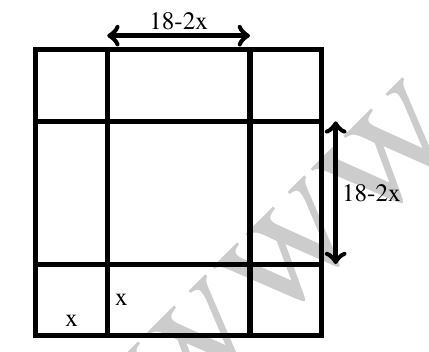
Let $V$ be the volume of the open box formed by folding up the flaps, then
$V = x(18 – 2x)(18 – 2x) = 4x{(9 – x)^2}$
$ = 4({x^3} – 18{x^2} + 81x)$ …(i)Differentiating (i) w.r.t. $x$, we get $\cfrac{{dV}}{{dx}} = 4(3{x^2} – 36x + 81) = 12({x^2} – 12x + 27)$
For maximum/minimum volume, $\cfrac{{dV}}{{dx}} = 0 \Rightarrow 12({x^2} – 12x + 27) = 0$$ \Rightarrow 12(x – 3)(x – 9) = 0 \Rightarrow x = 3,9$ but $0 < x < 9 \Rightarrow x = 3$
$\cfrac{{{d^2}V}}{{d{x^2}}} = 12(2x – 12) = 24(x – 6)$
and ${\left( {\cfrac{{{d^2}V}}{{d{x^2}}}} \right)_{x = 3}} = 24(3 – 6) = – 72 < 0$
$ \Rightarrow V$ has a maximum value at $x = 3$.Hence, the volume of the box is maximum when the side of the square to be cut off is $3{\rm{ cm}}$.
-
A rectangular sheet of tin $45{\rm{ cm by }}24{\rm{ cm}}$ is to be made into a box without top, by cutting off square from each corner and folding up the flaps. What should be the side of the square to be cut off so that the volume of the box is maximum?
SOLUTION
Let the side of the square to be cut from each of the four corners be $x{\rm{cm}}$, then the base of the box has dimensions $(45 – 2x)$ cm and $(24 – 2x)$ cm and height of the box is $x$ cm.
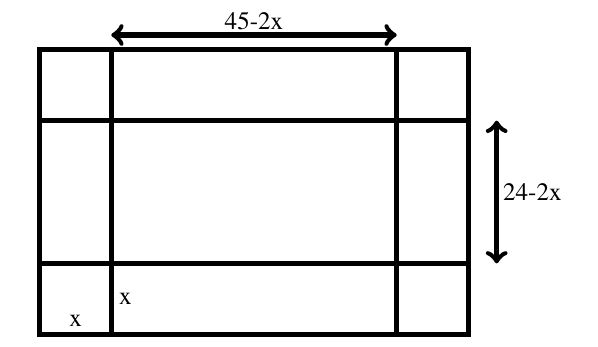
Let $V$ be the corresponding volume of the box, then
$V = x(24 – 2x)(45 – 2x)$
$ = x(4{x^2} – 138x + 1080)$
$ = 4{x^3} – 138{x^2} + 1080x$
$ \Rightarrow \cfrac{{dV}}{{dx}} = 12{x^2} – 276x + 1080$For maximum/minimum volume, $\cfrac{{dV}}{{dx}} = 0 \Rightarrow 12{x^2} – 276x + 1080 = 0$
$ \Rightarrow {x^2} – 23x + 90 = 0 \Rightarrow (x – 18)(x – 5) = 0$
$ \Rightarrow x = 5,x \ne 18$
$\cfrac{{{d^2}V}}{{d{x^2}}} = 24x – 276\,\,{\rm{and}}\,\,{\left( {\cfrac{{{d^2}V}}{{d{x^2}}}} \right)_{x = 5}} = 24 \times 5 – 276 < 0$$\therefore $ $V$ has maximum value at $x = 5$.
So, a square of side $5{\rm{ cm}}$ should be cut from each corner for the box to have a maximum volume.
-
Show that of all the rectangles inscribed in a given fixed circle, the square has the maximum area.
SOLUTION
Let $ABCD$ be a rectangle inscribed in the given circle of radius $r$ having centre at $O$.
Let one side of the rectangle be $x$, then the other side $ = \sqrt {{{(2r)}^2} – {x^2}} = \sqrt {4{r^2} – {x^2}} $ (; an angle in the semicircle) Let $A$ be the corresponding area of the rectangle, then
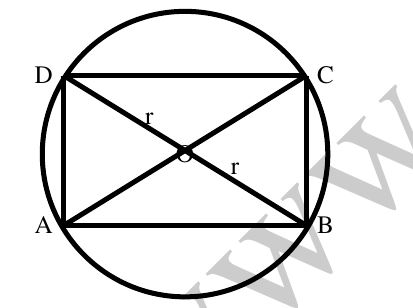
$A = x\sqrt {4{r^2} – {x^2}} ,0 < x < 2r$
$ \Rightarrow \cfrac{{dA}}{{dx}} = \cfrac{{x( – 2x)}}{{2\sqrt {4{r^2} – {x^2}} }} + \sqrt {4{r^2} – {x^2}} = \cfrac{{2(2{r^2} – {x^2})}}{{\sqrt {4{r^2} – {x^2}} }}$For maximum/minimum area, $\cfrac{{dA}}{{dx}} = 0 \Rightarrow \cfrac{{2{r^2} – {x^2}}}{{\sqrt {4{r^2} – {x^2}} }} = 0 \Rightarrow x = \sqrt 2 r$
Now, $\cfrac{{{d^2}A}}{{d{x^2}}} = \cfrac{{\sqrt {4{r^2} – {x^2}} ( – 4x) – (4{r^2} – 2{x^2})\cfrac{{1 \times ( – 2x)}}{{2\sqrt {4{r^2} – {x^2}} }}}}{{(4{r^2} – {x^2})}}$
$ = \cfrac{{(4{r^2} – {x^2})( – 4x) + (4{r^2} – 2{x^2})x}}{{{{(4{r^2} – {x^2})}^{3/2}}}} = \cfrac{{ – 12{r^2}x + 2{x^3}}}{{{{(4{r^2} – {x^2})}^{3/2}}}}$
${\left( {\cfrac{{{d^2}A}}{{d{x^2}}}} \right)_{x = \sqrt 2 r}} = \cfrac{{ – 12{r^2}(\sqrt 2 r) + 2{{(\sqrt 2 r)}^3}}}{{{{(2{r^2})}^{3/2}}}}$
$ = \cfrac{{4\sqrt 2 {r^3} – \sqrt 2 {r^3}}}{{2\sqrt 2 {r^3}}} = 2 – 6 < 0$
$\therefore $ Area is maximum at $x = \sqrt 2 r$$\therefore $ Length of rectangle is $\sqrt 2 r$ and width of rectangle is $\sqrt {4{r^2} – 2{r^2}} = \sqrt 2 r$
Hence, of all the rectangles the square of side $\sqrt 2 r$ units has the maximum area.
-
Show that the right circular cylinder of given surface and maximum volume is such that height is equal to the diameter of the base.
SOLUTION
Let $r$ be the radius of the circular base, $h$ be the height and $S$ be the total surface area of a right circular cylinder, then
$S = 2\pi {r^2} + 2\pi rh$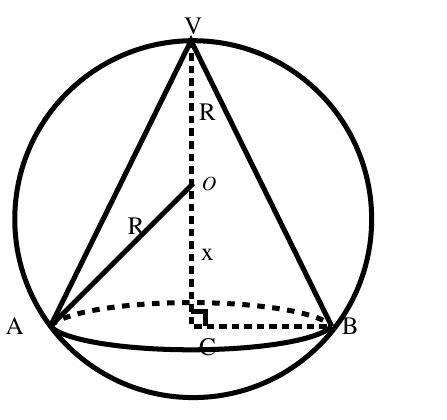
Let $V$ be the volume of cylinder with the above dimensions, then $V = \pi {r^2}h = \pi {r^2}\left( {\cfrac{{S – 2\pi {r^2}}}{{2\pi r}}} \right) = \cfrac{r}{2}(S – 2\pi {r^2})$
$ \Rightarrow V = \cfrac{{Sr}}{2} – \pi {r^3}$ … (i)Differentiating (i) w.r.t. $r$, we get $\cfrac{{dV}}{{dr}} = \cfrac{S}{2} – 3\pi {r^2}$
For maximum/minimum volume, $\cfrac{{dV}}{{dr}} = 0 \Rightarrow \cfrac{S}{2} – 3\pi {r^2} = 0 \Rightarrow {r^2} = \cfrac{S}{{6\pi }} \Rightarrow r = \sqrt {\cfrac{S}{{6\pi }}} $
$\cfrac{{{d^2}V}}{{d{r^2}}} = – 6\pi r\,\,{\rm{and }}{\left( {\cfrac{{{d^2}V}}{{d{r^2}}}} \right)_{r = \sqrt {S/(6\pi )} }} = – 6\pi \sqrt {\cfrac{S}{{6\pi }}} < 0$
$\therefore $ V has a maximum value at $r = \sqrt {\cfrac{S}{{6\pi }}} $.
When $r = \sqrt {\cfrac{S}{{6\pi }}} $, then $h = \cfrac{{S – 2\pi {r^2}}}{{2\pi r}} = \cfrac{{S – 2\pi \left( {\cfrac{S}{{6\pi }}} \right)}}{{2\pi \sqrt {\cfrac{S}{{6\pi }}} }} = \cfrac{{4\pi S/6\pi }}{{2\pi \sqrt {\cfrac{S}{{6\pi }}} }}$$ \Rightarrow h = 2\sqrt {\cfrac{S}{{6\pi }}} = 2$ (radius)=diameter
So, volume is maximum when the height is equal to the diameter of the base. -
Of all the closed cylindrical cans (right circular), of a given volume of 100 cubic centimetres, of the dimensions of the can which has the minimum surface area.
SOLUTION
Let $r$ cm be the radius, $h$ cm be the height, $S$ cm$^2$ be the total surface area and $V$ cm$^3$ be the volume, then
$V = \pi {r^2}h = 100 \Rightarrow h = \cfrac{{100}}{{\pi {r^2}}}$ …(i)
and $S = 2\pi {r^2} + 2\pi rh$ …(ii)$ \Rightarrow S = 2\pi {r^2} + 2\pi r\left( {\cfrac{{100}}{{\pi {r^2}}}} \right) = 2\pi {r^2} + \cfrac{{200}}{r}$ (using (i))
Differentiating $S = 2\pi {r^2} + \cfrac{{200}}{r}$ w.r.t. $r$, we get $\cfrac{{dS}}{{dr}} = 4\pi r – \cfrac{{200}}{{{r^2}}}$
For maximum/minimum surface area, $\cfrac{{dS}}{{dr}} = 0 \Rightarrow 4\pi r – \cfrac{{200}}{{{r^2}}} = 0 \Rightarrow {r^3} = \cfrac{{200}}{{4\pi }} \Rightarrow r = {\left( {\cfrac{{50}}{\pi }} \right)^{1/3}}$
$\cfrac{{{d^2}S}}{{d{r^2}}} = 4\pi + \cfrac{{200 \times 2}}{{{r^3}}} = 4\pi + \cfrac{{400}}{{{r^3}}}$
and ${\left( {\cfrac{{{d^2}S}}{{d{r^2}}}} \right)_{r = {{(50/\pi )}^{1/3}}}} = 4\pi + \cfrac{{400}}{{(50/\pi )}} > 0$
$\therefore $ $S$ has a minimum, when $r = {\left( {\cfrac{{50}}{\pi }} \right)^{1/3}}$When $r = {\left( {\cfrac{{50}}{\pi }} \right)^{1/3}}$
$h = \cfrac{{100}}{{\pi {r^2}}} = \cfrac{{100}}{{\pi {{\left( {\cfrac{{50}}{\pi }} \right)}^{2/3}}}} = \cfrac{{100}}{{{{(50)}^{2/3}}{\pi ^{1/3}}}} = \cfrac{{50 \times 2}}{{{{(50)}^{2/3}}{\pi ^{1/3}}}} = 2{\left( {\cfrac{{50}}{\pi }} \right)^{1/3}}$Therefore, radius $ = {\left( {\cfrac{{50}}{\pi }} \right)^{\cfrac{1}{3}}}$ cm and height $ = 2{\left( {\cfrac{{50}}{\pi }} \right)^{\cfrac{1}{3}}}$ cm.
-
A wire of length $28{\rm{ m}}$ is to be cut into two pieces. One of the pieces is to be made into a square and the other into a circle. What should be the lengths of the two pieces so that the combined area of the square and the circle is minimum?
SOLUTION
Let the length of the piece bent into the shape of a circle be $x{\rm{m}}$ and so length of the other piece bent into the shape of a square is $(28 – x){\rm{m}}$.
Circumference of circle $ = 2\pi r \Rightarrow 2\pi r = x \Rightarrow r = \cfrac{x}{{2\pi }}$
$ \Rightarrow $ Area of the circle$ = \pi {(r)^2} = \pi {\left( {\cfrac{x}{{2\pi }}} \right)^2} = \cfrac{{{x^2}}}{{4\pi }}$ .Perimeter of square $ = 4$(side)$ \Rightarrow 28 – x = 4{\rm{(side)}}$
$ \Rightarrow $ Side $ = \cfrac{{28 – x}}{4}$$ \Rightarrow $ Area of the square $ = {\left( {{\rm{side}}} \right)^2} = {\left( {\cfrac{{28 – x}}{4}} \right)^2} = \cfrac{{{{(28 – x)}^2}}}{{16}}$.
Let $A$ be the sum of the areas of the two shapes, then
$A = \cfrac{{{x^2}}}{{4\pi }} + \cfrac{{{{(28 – x)}^2}}}{{16}}$ … (i)
Differentiating (i) w.r.t. $x$, we get $\cfrac{{dA}}{{dx}} = \cfrac{{2x}}{{4\pi }} + \cfrac{{2(28 – x)( – 1)}}{{16}} = \cfrac{x}{{2\pi }} – \cfrac{{28 – x}}{8}$For maximum/minimum area, $\cfrac{{dA}}{{dx}} = 0$
$ \Rightarrow \cfrac{x}{{2\pi }} – \cfrac{{28 – x}}{8} = 0 \Rightarrow \cfrac{{4x – 28\pi + x\pi }}{{8\pi }} = 0$$ \Rightarrow 4x + x\pi = 28\pi \Rightarrow x = \cfrac{{28\pi }}{{4 + \pi }}$
$\cfrac{{{d^2}A}}{{d{x^2}}} = \cfrac{1}{{2\pi }} – \cfrac{{( – 1)}}{8} = \cfrac{1}{{2\pi }} + \cfrac{1}{8}$ and ${\left( {\cfrac{{{d^2}A}}{{d{x^2}}}} \right)_{x = \cfrac{{28\pi }}{{4 + \pi }}}} = \cfrac{1}{{2\pi }} + \cfrac{1}{8} > 0$
Hence, area $A$ is minimum at $x = \cfrac{{28\pi }}{{4 + \pi }}$
$\therefore $ The wire must be cut at a distance of $\cfrac{{28\pi }}{{4 + \pi }}{\rm{m}}$ from one end.Hence, the lengths of the two pieces are $28 – \cfrac{{28\pi }}{{4 + \pi }} = \cfrac{{112}}{{4 + \pi }}{\rm{m}}$ and $\cfrac{{28\pi }}{{4 + \pi }}{\rm{m}}$.
-
Prove that the volume of the largest cone that can be inscribed in a sphere of radius $R$ is $8/27$ of the volume of the sphere.
SOLUTION
Let $PAB$ be a cone of greatest volume inscribed in the sphere. Let $OC = x$. Then in $\Delta OAC,AC = \sqrt {{R^2} – {x^2}} $ and $PC = PO + OC = R + x =$height of the cone.
Let $V$ be the volume of the cone. Then,
$V = \cfrac{1}{3}\pi {(AC)^2}(PC)$
$ \Rightarrow V = \cfrac{1}{3}\pi ({R^2} – {x^2})(R + x)$$ = \cfrac{1}{3}\pi ({R^3} + x{R^2} – R{x^2} – {x^3})$ …(i)
Differentiating (i) w.r.t. $x$, we get $\cfrac{{dV}}{{dx}} = \cfrac{1}{3}\pi \left[ {({R^2} – {x^2}) – 2x(R + x)} \right]$
$ \Rightarrow \cfrac{{dV}}{{dx}} = \cfrac{1}{3}\pi ({R^2} – 2Rx – 3{x^2})$For maximum/minimum $V$ we must have $\cfrac{{dV}}{{dx}} = 0$
$ \Rightarrow {R^2} – 2Rx – 3{x^2} = 0 \Rightarrow (R – 3x)(R + x) = 0$$ \Rightarrow R – 3x = 0 \Rightarrow x = \cfrac{R}{3}$
$\cfrac{{{d^2}V}}{{d{x^2}}} = \cfrac{1}{3}\pi ( – 2R – 6x)$ and ${\left( {\cfrac{{{d^2}V}}{{d{x^2}}}} \right)_{x = R/3}} = – \cfrac{4}{3}R\pi < 0$Thus, $V$ is maximum when $x = \cfrac{R}{3}$.
Putting $x = \cfrac{R}{3}$ in $V = \cfrac{1}{3}\pi ({R^2} – {x^2})(R + x)$ , we obtainMaximum volume of the cone $ = \cfrac{1}{3}\pi \left( {{R^2} – \cfrac{{{R^2}}}{9}} \right)\left( {R + \cfrac{R}{3}} \right)$
$ \Rightarrow $ Maximum volume of the cone $ = \cfrac{{32\pi {R^3}}}{{81}}$$ \Rightarrow $ Maximum volume of the cone $ = \cfrac{8}{{27}}\left( {\cfrac{4}{3}\pi {R^3}} \right)$
$ = \cfrac{8}{{27}}$ (Volume of the sphere)
Hence proved. -
Show that the right circular cone of least curved surface and given volume has an altitude equal to $\sqrt 2 $ times the radius of the base.
SOLUTION
Let $r$ and $h$ be the radius and height respectively of the cone $ABC$
Volume, $V = \cfrac{1}{3}\pi {r^2}h \Rightarrow h = \cfrac{{3V}}{{\pi {r^2}}}$
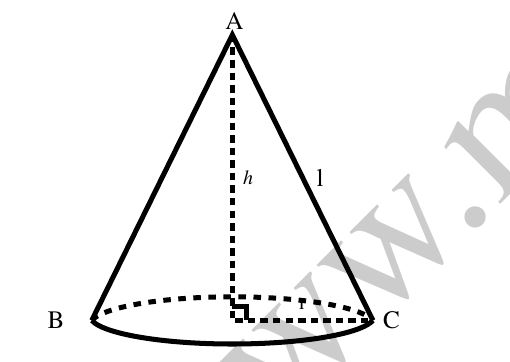
Curved surface area, $S = \pi rl$
$ = \pi r\left( {\sqrt {{h^2} + {r^2}} } \right) = \pi r\left( {\sqrt {{{\left( {\cfrac{{3V}}{{\pi {r^2}}}} \right)}^2} + {r^2}} } \right)$
${S^2} = {(\pi r)^2}\left[ {{{\left( {\cfrac{{3V}}{{\pi {r^2}}}} \right)}^2} + {r^2}} \right] = \cfrac{{{{(3V)}^2}}}{{{r^2}}} + {\pi ^2}{r^4}$Let $Z = {S^2}$
$ \Rightarrow Z = \cfrac{{{{(3V)}^2}}}{{{r^2}}} + {\pi ^2}{r^4}$ …(i)
Differentiating (i) w.r.t. $r$, we get $\cfrac{{dZ}}{{dr}} = \cfrac{{ – 2{{(3V)}^2}}}{{{r^3}}} + 4{\pi ^2}{r^3}$For maximum/minimum surface area, $\cfrac{{dZ}}{{dr}} = 0$
$ \Rightarrow \cfrac{{ – 2{{(3V)}^2}}}{{{r^3}}} + 4{\pi ^2}{r^3} = 0 \Rightarrow – 2{(3V)^2} + 4{\pi ^2}{r^6} = 0$
$ \Rightarrow – {(3V)^2} + 2{\pi ^2}{r^6} = 0 \Rightarrow 2{\pi ^2}{r^6} = {(3V)^2}$
$ \Rightarrow {r^6} = \cfrac{{{{(3V)}^2}}}{{2{\pi ^2}}} = \cfrac{{{{\left( {3\left( {\cfrac{1}{3}\pi {r^2}h} \right)} \right)}^2}}}{{2{\pi ^2}}} = \cfrac{{{r^4}{h^2}}}{2}$
$ \Rightarrow {r^2} = \cfrac{{{h^2}}}{2} \Rightarrow 2{r^2} = {h^2}$$\cfrac{{{d^2}Z}}{{d{r^2}}} = – 2{(3V)^2}\left[ {\cfrac{{ – 3}}{{{r^4}}}} \right] + 12{\pi ^2}{r^2}$ and ${\left( {\cfrac{{{d^2}Z}}{{d{r^2}}}} \right)_{{r^2} = \cfrac{{{h^2}}}{2}}} > 0$
Hence, surface area is minimum at $2{r^2} = {h^2} \Rightarrow h = \sqrt 2 r$
-
Show that the semi-vertical angle of the cone of maximum volume and of given slant height is ${\tan ^{ – 1}}\sqrt 2 $.
SOLUTION
Let $\theta $ be the semi vertical angle, $l$ be the given slant height, then radius of base $\left( r \right) = l\sin \theta $, height$\left( h \right) = l\cos \theta $ and volume of cone$ = \cfrac{1}{3}\pi {r^2}h$
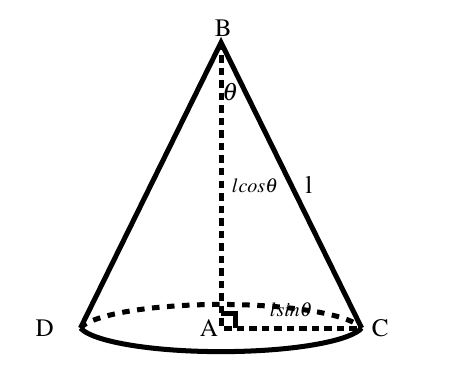
$ \Rightarrow V = \cfrac{1}{3}\pi {\left( {l\sin \theta } \right)^2}l\cos \theta = \cfrac{1}{3}\pi {l^3}{\sin ^2}\theta \cos \theta $
$ \Rightarrow \cfrac{{dV}}{{d\theta }} = \cfrac{1}{3}\pi {l^3}\left\{ {\left( {{{\sin }^2}\theta } \right)\left( { – \sin \theta } \right) + \cos \theta \times 2\sin \theta \cos \theta } \right\}$
$ = \cfrac{1}{3}\pi {l^3}\sin \theta \left[ { – {{\sin }^2}\theta + 2\left( {1 – {{\sin }^2}\theta } \right)} \right]$
$ = \cfrac{1}{3}\pi {l^3}\sin \theta {\cos ^2}\theta \left[ {2{{\sec }^2}\theta – 3{{\tan }^2}\theta } \right]$$ = \cfrac{1}{3}\pi {l^3}\sin \theta {\cos ^2}\theta \left[ {2 – {{\tan }^2}\theta } \right]$
For maximum/minimum volume, $\cfrac{{dV}}{{d\theta }} = 0$
$ \Rightarrow \cfrac{1}{3}\pi {l^3}\sin \theta {\cos ^2}\theta \left( {2 – {{\tan }^2}\theta } \right) = 0 \Rightarrow {\tan ^2}\theta = 2$$ \Rightarrow \tan \theta = \left( {\sqrt 2 } \right)$
$ \Rightarrow \theta = {\tan ^{ – 1}}\left( {\sqrt 2 } \right)$$\cfrac{{{d^2}V}}{{d{\theta ^2}}} = \cfrac{1}{3}\pi {l^3}{\cos ^3}\theta \left( {2 – 7{{\tan }^2}\theta } \right)$
$ \Rightarrow {\left( {\cfrac{{{d^2}V}}{{d{\theta ^2}}}} \right)_{\tan \theta = \sqrt 2 }} = \cfrac{1}{3}\pi {l^3}{\left( {\cfrac{1}{{\sqrt 3 }}} \right)^3}\left( {2 – 7 \times 2} \right) = – \cfrac{{4\pi {l^3}}}{{3\sqrt 3 }} < 0$Thus, $V$ is maximum, when $\tan \theta = \sqrt 2 $ or $\theta = {\tan ^{ – 1}}\sqrt 2 $
Thus, the semi-vertical angle of the cone is ${\tan ^{ – 1}}\sqrt 2 $. -
Show that the semi-vertical angle of right circular cone of given surface area and maximum volume is ${\sin ^{ – 1}}\left( {\cfrac{1}{3}} \right)$
SOLUTION
Let $r$ be the radius, $l$ be the slant height and $h$ be the vertical height and $\alpha $ be the semi-vertical angle of cone of given surface area $S$. Then,
$S = \pi rl + \pi {r^2} \Rightarrow l = \cfrac{{S – \pi {r^2}}}{{\pi r}}$
Let $V$ be the volume of the cone.
$\therefore $ $V = \cfrac{1}{3}\pi {r^2}h$
$ \Rightarrow {V^2} = \cfrac{1}{9}{\pi ^2}{r^4}{h^2} = \cfrac{1}{9}{\pi ^2}{r^4}\left( {{l^2} – {r^2}} \right)$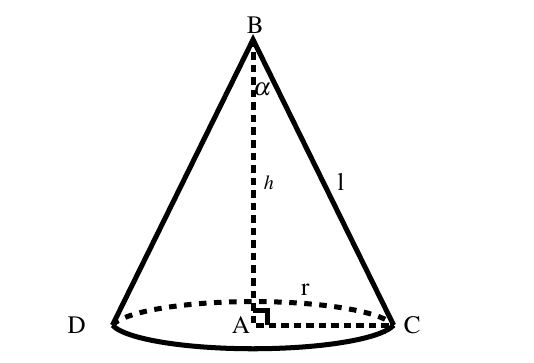
$ \Rightarrow {V^2} = \cfrac{{{\pi ^2}}}{9}{r^4}\left[ {{{\left( {\cfrac{{S – \pi {r^2}}}{{\pi r}}} \right)}^2} – {r^2}} \right] = \cfrac{{{\pi ^2}{r^4}}}{9}\left[ {\cfrac{{{{(S – \pi {r^2})}^2} – {\pi ^2}{r^4}}}{{{\pi ^2}{r^2}}}} \right]$
$ \Rightarrow {V^2} = \cfrac{1}{9}S(S{r^2} – 2\pi {r^4})$
Let $Z = {V^2}$, then $y$ is maximum or minimum according as $Z$ is maximum or minimum.
$\therefore Z = \cfrac{1}{9}S\left( {S{r^2} – 2\pi {r^4}} \right) \Rightarrow \;\cfrac{{dZ}}{{dr}} = \cfrac{1}{9}S\left( {2Sr – 8\pi {r^3}} \right)$For maximum/minimum $Z$, we have $\cfrac{{dZ}}{{dr}} = 0$
$ \Rightarrow 2Sr – 8\pi {r^3} = 0 \Rightarrow S = 4\pi {r^2} \Rightarrow r = \sqrt {\cfrac{S}{{4\pi }}} $
Now, $\cfrac{{{d^2}Z}}{{d{r^2}}} = \cfrac{S}{9}(2S – 24\pi {r^2})$
$ \Rightarrow {\left( {\cfrac{{{d^2}Z}}{{d{r^2}}}} \right)_{r = \sqrt {\cfrac{S}{{4\pi }}} }} = \cfrac{S}{9}\left( {2S – 24\pi \cfrac{S}{{4\pi }}} \right)$$ \Rightarrow \cfrac{{{d^2}Z}}{{d{r^2}}} = – \cfrac{{4{S^2}}}{9} < 0$
So, $Z$ is maximum when $S = 4\pi {r^2}$.
Hence, $V$ is maximum when $S = 4\pi {r^2}$Now, $S = 4\pi {r^2} \Rightarrow \pi rl + \pi {r^2} = 4\pi {r^2} \Rightarrow l = 3r$
In $\Delta AOC$
$\sin \alpha = \cfrac{r}{l} = \cfrac{r}{{3r}} = \cfrac{1}{3} \Rightarrow \alpha = {\sin ^{ – 1}}\cfrac{1}{3}$Hence $V$ is maximum when $\alpha = {\sin ^{ – 1}}\cfrac{1}{3}$.
-
Choose the correct answer in the Exercise from 27 to 29.
The point on the curve ${x^2} = 2y$ which is nearest to the point $(0,5)$ is
(A) $(2\sqrt 2 ,4)$
(B) $(2\sqrt 2 ,0)$
(C) $(0,0)$
(D) $(2,2)$
SOLUTION
(A): Let $Z$ be the square of distance of the point $P(x,y)$ on ${x^2} = 2y$ from the point $A(0,\;5)$ , then $Z = |PA{|^2}$
$ \Rightarrow Z = {(x – 0)^2} + {(y – 5)^2} = 2y + {(y – 5)^2} = {y^2} – 8y + 25$
$ \Rightarrow \cfrac{{dZ}}{{dy}} = 2y – 8$Now, $\cfrac{{dZ}}{{dy}} = 0 \Rightarrow 2y – 8 = 0 \Rightarrow y = 4$
$\therefore $ ${x^2} = 2(4) = 8$[From ${x^2} = 2y$]$ \Rightarrow x = 2\sqrt 2 $
${\left( {\cfrac{{{d^2}Z}}{{d{y^2}}}} \right)_{y = 4}} = 2 > 0$
Hence, $Z$ is minimum at $(2\sqrt 2 ,4)$ -
For all real values of $x$, the minimum value of $\cfrac{{1 – x + {x^2}}}{{1 + x + {x^2}}}$ is
(A) $0$
(B) $1$
(C) $3$
(D) $(1/3)$
SOLUTION
(D): Let $y = \cfrac{{{x^2} – x + 1}}{{{x^2} + x + 1}} \Rightarrow \cfrac{{dy}}{{dx}} = \cfrac{{2(x – 1)(x + 1)}}{{{{({x^2} + x + 1)}^2}}}$
For critical points, we have $\cfrac{{dy}}{{dx}} = 0 \Rightarrow x = 1, – 1$
At $x = 1,\cfrac{{dy}}{{dx}}$ changes its sign from $ – ve$ to $ + ve$.
At $x = – 1,\cfrac{{dy}}{{dx}}$ changes its sign from $ + ve$ to $ – ve$.
Thus, $y$ is minimum at $x = 1$.
$\therefore $ Minimum value of $y = \cfrac{{1 – x + {x^2}}}{{1 + x + {x^2}}}$ at $x = 1$ is $\cfrac{{1 – 1 + 1}}{{1 + 1 + 1}} = \cfrac{1}{3}$. -
The maximum value of ${[x(x – 1) + 1]^{1/3}},0 \le x \le 1$ is
(A) ${\left( {\cfrac{1}{3}} \right)^{1/3}}$
(B) $\cfrac{1}{2}$
(C) $1$
(D) $0$
SOLUTION
(C): Let $f(x) = {[x(x – 1) + 1]^{1/3}} = {({x^2} – x + 1)^{1/3}},0 \le x \le 1$
$ \Rightarrow f'(x) = \cfrac{1}{3}{({x^2} – x + 1)^{\cfrac{1}{3} – 1}}(2x – 1) = \cfrac{1}{3}{({x^2} – x + 1)^{\cfrac{{ – 2}}{3}}}(2x – 1)$
For critical points, $f'(x) = 0 \Rightarrow 2x – 1 = 0 \Rightarrow x = \cfrac{1}{2} \in [0,1]$
For maximum or minimum value of $f$, we evaluate $f(0),f(1)$ and $f(1/2)$ .
Here, $f(0) = {(0 – 0 + 1)^{1/3}} = 1,f(1) = {(1(0) + 1)^{1/3}} = 1$
and $f\left( {\cfrac{1}{2}} \right) = {\left( {\cfrac{1}{4} – \cfrac{1}{2} + 1} \right)^{1/3}} = {\left( {\cfrac{3}{4}} \right)^{1/3}}$Maximum value of $f(x)$ is $1$.
NCERT – Miscellaneous Exercise
-
Using differentials, find the approximate value of each of the following :
(a) ${\left( {\cfrac{{17}}{{81}}} \right)^{1/4}}$
(b) ${(33)^{1/5}}$
SOLUTION
(a) Let $f(x) = {x^{1/4}} \Rightarrow f'(x) = \cfrac{1}{4}{x^{ – 3/4}}$
Take $x = \cfrac{{16}}{{81}}$ and $\Delta x = \cfrac{1}{{81}}$
As, $f(x + \Delta x) \approx f(x) + \Delta x f'(x) \Rightarrow {(x + \Delta x)^{1/4}} \approx {x^{1/4}} + \cfrac{{\Delta x}}{{4{x^{3/4}}}}$
$ \Rightarrow {\left( {\cfrac{{16}}{{81}} + \cfrac{1}{{81}}} \right)^{1/4}} \approx {\left( {\cfrac{{16}}{{81}}} \right)^{1/4}} + \cfrac{{1/81}}{{4{{\left( {\cfrac{{16}}{{81}}} \right)}^{3/4}}}}$
$ \Rightarrow {\left( {\cfrac{{17}}{{81}}} \right)^{1/4}} \approx \cfrac{2}{3} + \cfrac{1}{{81 \times 4 \times {{\left( {\cfrac{2}{3}} \right)}^3}}} = \cfrac{2}{3} + \cfrac{1}{{96}} = \cfrac{{65}}{{96}}$
$\therefore $ ${\left( {\cfrac{{17}}{{81}}} \right)^{1/4}} \approx 0.677.$(b) Let $f(x) = {x^{ – 1/5}} \Rightarrow f'(x) = \cfrac{{ – 1}}{5}{x^{ – 6/5}}.$
Take $x = 32$ and $\Delta x = 1$
As, $f(x + \Delta x) \approx f(x) + \Delta x f'(x) \Rightarrow {(x + \Delta x)^{ – 1/5}} \approx {x^{ – 1/5}} – \cfrac{{\Delta x}}{{5{x^{6/5}}}}$$ \Rightarrow {(33)^{ – 1/5}} \approx {(32)^{ – 1/5}} – \cfrac{1}{{5{{(32)}^{6/5}}}} = \cfrac{1}{2} – \cfrac{1}{{5 \times {2^6}}}$.
$ = 0.5 – \cfrac{1}{{320}} = 0.5 – 0.003$
$\therefore $ ${(33)^{ – 1/5}} \approx 0.497.$ -
Show that the function given by $f(x) = \cfrac{{\log x}}{x}$ has maximum at $x = e$.
SOLUTION
We have, $f(x) = \cfrac{{\log x}}{x}, x > 0$ …(i)
Differentiating (i) w.r.t. $x$, we get $f'(x) = \cfrac{{x\left( {\cfrac{1}{x}} \right) – (\log x) \cdot 1}}{{{x^2}}} = \cfrac{{1 – \log x}}{{{x^2}}}$ …(ii)For maximum/minimum, $f'(x) = 0$
$ \Rightarrow \cfrac{{1 – \log x}}{{{x^2}}} = 0 \Rightarrow \log x = 1$
$ \Rightarrow x = e$Differentiating (ii) w.r.t. $x$, we get
$f”(x) = \cfrac{{{x^2}\left( { – \cfrac{1}{x}} \right) – (1 – \log x)2x}}{{{x^4}}} = \cfrac{{ – x – 2x + 2x\log x}}{{{x^4}}}$$ = \cfrac{{x(2\log x – 3)}}{{{x^4}}} = \cfrac{{2\log x – 3}}{{{x^3}}}$
Also, $f”(e) = \cfrac{{2\log e – 3}}{{{e^3}}} = \cfrac{{2 \cdot 1 – 3}}{{{e^3}}} = \cfrac{{ – 1}}{{{e^3}}} < 0$
$ \Rightarrow f(x)$ has maximum at $x = e.$
-
The two equal sides of an isosceles triangle with fixed base $b$ are decreasing at rate of $3$ cm per second. How fast is the area decreasing when the two equal sides are equal to the base?
SOLUTION
Let us take either of the equal sides $AB$ & $AC$ of $\Delta ABC$ be $x$ at any instant of time $t$.
$ \Rightarrow \cfrac{{dx}}{{dt}} = -3 \text{ cm/sec}$If $A$ is the area of $\Delta ABC$ at time $t$, then
$A = \cfrac{1}{2} \text{base} \times \text{height} = \cfrac{1}{2} b \sqrt{AB^2 – BD^2}$$ = \cfrac{b}{2} \sqrt{x^2 – \left( \cfrac{b}{2} \right)^2} = \cfrac{b}{4} \sqrt{4x^2 – b^2}$
$\therefore $ $\cfrac{{dA}}{{dt}} = \cfrac{b}{4} \times \cfrac{1}{2} \times \cfrac{8x}{\sqrt{4x^2 – b^2}} \cfrac{dx}{dt} = \cfrac{bx}{\sqrt{4x^2 – b^2}} \cfrac{dx}{dt}$
${\left( \cfrac{dA}{dt} \right)}_{x = b} = \left( \cfrac{b \times b}{\sqrt{4b^2 – b^2}} \right)(-3) = -\sqrt{3} b$ $\left[ \therefore \cfrac{dx}{dt} = -3 \right]$
$\therefore $ Area is decreasing at the rate of $b\sqrt{3} \text{ cm}^2/\text{sec}$.
-
Find the equation of the normal to curve $y^2 = 4x$ at the point $(1,2)$.
SOLUTION
We have, $y^2 = 4x$ …(i)
Differentiating (i) w.r.t. $x$, we get $2y \cfrac{dy}{dx} = 4 \Rightarrow \cfrac{dy}{dx} = \cfrac{4}{2y} = \cfrac{2}{y}$$\therefore $ Slope of tangent to (i) at $(1,2)$ is ${\left( \cfrac{dy}{dx} \right)}_{(1,2)} = 1$
$ \Rightarrow $ Slope of normal to (i) at $(1,2) = -1$$\therefore $ Equation of normal to (i) at $(1,2)$ is
$(y – 2) = -1(x – 1)$
$ \Rightarrow x + y – 3 = 0.$ -
Show that the normal at any point $\theta$ to the curve $x = a\cos \theta + a\theta \sin \theta , y = a\sin \theta – a\theta \cos \theta$ is at a constant distance from the origin.
SOLUTION
We have,
$x = a\cos \theta + a\theta \sin \theta$ …(i) and
$y = a\sin \theta – a\theta \cos \theta$ …(ii)Differentiating (i) & (ii) w.r.t. $\theta$, we get
$\cfrac{dx}{d\theta} = -a\sin \theta + a\{ \theta \cos \theta + \sin \theta \} = a\theta \cos \theta$
and $\cfrac{dy}{d\theta} = a\cos \theta – a\{ \theta (-\sin \theta) + \cos \theta \} = a\theta \sin \theta$
$\therefore $ Slope of the tangent at $\theta$ is given by
$\cfrac{dy}{dx} = \cfrac{dy/d\theta}{dx/d\theta} = \cfrac{a\theta \sin \theta}{a\theta \cos \theta} = \tan \theta$$ \Rightarrow $ Slope of the normal at $\theta$ is $-\cot \theta$
The equation of the normal at $\theta$ is
$y – (a\sin \theta – a\theta \cos \theta) = -\cfrac{\cos \theta}{\sin \theta}(x – (a\cos \theta + a\theta \sin \theta))$$ \Rightarrow y\sin \theta – a\sin^2 \theta + a\theta \sin \theta \cos \theta = -x\cos \theta + a\cos^2 \theta + a\theta \sin \theta \cos \theta$
$ \Rightarrow x\cos \theta + y\sin \theta = a(\sin^2 \theta + \cos^2 \theta)$
$ \Rightarrow x\cos \theta + y\sin \theta = a$, which is in the normal form.Its distance from the origin $ = \cfrac{| – a|}{\sqrt{\cos^2 \theta + \sin^2 \theta}} = \cfrac{a}{\sqrt{1}} = a$, which is constant.
-
Find the intervals in which the function $f$ given by $f(x) = \cfrac{{4\sin x – 2x – x\cos x}}{{2 + \cos x}}$ is
(i) increasing
(ii) decreasingSOLUTION
We have, $f(x) = \cfrac{4\sin x – 2x – x\cos x}{2 + \cos x}$
$ = \cfrac{4\sin x – x(2 + \cos x)}{2 + \cos x}$
$ \Rightarrow \cfrac{4\sin x}{2 + \cos x} – \cfrac{x(2 + \cos x)}{2 + \cos x} = \cfrac{4\sin x}{2 + \cos x} – x$ …(i)Differentiating (i) w.r.t. $x$, we get
$f'(x) = 4\left\{ \cfrac{(2 + \cos x)\cos x – \sin x(0 – \sin x)}{(2 + \cos x)^2} \right\} – 1$$ = 4\left\{ \cfrac{2\cos x + \cos^2 x + \sin^2 x}{(2 + \cos x)^2} \right\} – 1$
$ = \cfrac{8\cos x + 4 – (2 + \cos x)^2}{(2 + \cos x)^2} = \cfrac{\cos x(4 – \cos x)}{(2 + \cos x)^2}$Now, $(2 + \cos x)^2$ being a perfect square is always non-negative.
Also, $(2 + \cos x)^2 \ne 0$ as $(2 + \cos x) \ne 0$$\therefore $ $(2 + \cos x)^2$ is always $+ve$ and $4 – \cos x$ is also always $+ve$, as $\cos x$ is always numerically $\le 1$
(i) For $f(x)$ to be increasing function of $x$, $f'(x) > 0$.
$ \Rightarrow \cos x > 0 \Rightarrow x \in \left(0, \cfrac{\pi}{2}\right) \cup \left(\cfrac{3\pi}{2}, 2\pi\right)$$\therefore $ $f(x)$ is increasing in $\left(0, \cfrac{\pi}{2}\right) \cup \left(\cfrac{3\pi}{2}, 2\pi\right)$.
(ii) For $f(x)$ to be decreasing, $f'(x) < 0$
$ \Rightarrow \cos x < 0 \Rightarrow x \in \left(\cfrac{\pi}{2}, \cfrac{3\pi}{2}\right)$
$\therefore $ $f(x)$ is decreasing in $\left(\cfrac{\pi}{2}, \cfrac{3\pi}{2}\right)$. -
Find the intervals in which the function $f$ given by $f(x) = x^3 + \cfrac{1}{x^3}, x \ne 0$ is
(i) increasing
(ii) decreasing.SOLUTION
We have, $f(x) = x^3 + \cfrac{1}{x^3}$ …(i)
Differentiating (i) w.r.t. $x$, we get $f'(x) = 3x^2 – \cfrac{3}{x^4}$(i) For $f(x)$ to be increasing function of $x$,
$f'(x) > 0 \Rightarrow 3\left( x^2 – \cfrac{1}{x^4} \right) > 0$
$ \Rightarrow x^6 – 1 > 0 \Rightarrow (x^3 – 1)(x^3 + 1) > 0$Either $x^3 – 1 > 0$ and $x^3 + 1 > 0$
$ \Rightarrow x^3 > 1$ and $x^3 > -1 \Rightarrow x > 1$ and $x > -1$
$ \Rightarrow x > 1 \Rightarrow x \in (1, \infty)$
Or $x^3 – 1 < 0$ and $x^3 + 1 < 0$
$ \Rightarrow x^3 < 1$ and $x^3 < -1 \Rightarrow x < 1$ and $x < -1$
$ \Rightarrow x < -1 \Rightarrow x \in (-\infty, -1)$Hence, $f(x)$ is increasing in $(-\infty, -1) \cup (1, \infty)$.
(ii) For $f(x)$ to be decreasing function of $x$,
$f'(x) < 0 \Rightarrow 3\left( x^2 - \cfrac{1}{x^4} \right) < 0$
$ \Rightarrow x^2 – \cfrac{1}{x^4} < 0 \Rightarrow x^6 - 1 < 0 \Rightarrow (x^3 - 1)(x^3 + 1) < 0$Either $x^3 – 1 > 0$ and $x^3 + 1 < 0$
$ \Rightarrow x^3 > 1$ and $x^3 < -1 \Rightarrow x > 1$ and $x < -1$, which is not possible as there is no common value of $x$.
Or $x^3 – 1 < 0$ and $x^3 + 1 > 0$
$ \Rightarrow x^3 < 1$ and $x^3 > -1 \Rightarrow x < 1$ and $x > -1 \Rightarrow -1 < x < 1.$
Hence, $f(x)$ is decreasing in $(-1, 1)$. -
Find the maximum area of an isosceles triangle inscribed in the ellipse $\cfrac{x^2}{a^2} + \cfrac{y^2}{b^2} = 1$ with its vertex at one end of the major axis.
SOLUTION
The given equation of the ellipse is $\cfrac{x^2}{a^2} + \cfrac{y^2}{b^2} = 1$, then any point $P$ on the ellipse is $(a\cos \theta, b\sin \theta)$.
From $P$, draw $PQ$ parallel to $y$-axis to meet the ellipse again at $Q$, then $PAQ$ is an isosceles triangle. Let $A$ be its area, then
$A = \cfrac{1}{2} PQ \cdot AL = \cfrac{1}{2} (2b\sin \theta)(a – a\cos \theta)$$ \Rightarrow A = (a – a\cos \theta) \times b\sin \theta \Rightarrow A = ab(\sin \theta – \sin \theta \cos \theta)$
$ \Rightarrow A = ab(\sin \theta – \cfrac{1}{2}\sin 2\theta)$ …(i)Differentiating (i) w.r.t. $\theta$, we get $\cfrac{dA}{d\theta} = ab(\cos \theta – \cos 2\theta)$ …(ii)
For maxima/minima of $A$, $\cfrac{dA}{d\theta} = 0 \Rightarrow \cos \theta = \cos 2\theta$
$ \Rightarrow \cos 2\theta = \cos(2\pi – \theta) \Rightarrow 2\theta = 2\pi – \theta \Rightarrow \theta = \cfrac{2\pi}{3}$Differentiating (ii) w.r.t. $\theta$, we get
$\cfrac{d^2 A}{d\theta^2} = ab(-\sin \theta + 2\sin 2\theta)$ …(iii)Now, ${\left( \cfrac{d^2 A}{d\theta^2} \right)}_{\theta = \cfrac{2\pi}{3}} = ab\left( -\sin \cfrac{2\pi}{3} + 2\sin \cfrac{4\pi}{3} \right)$
$ = ab\left( -\cfrac{\sqrt{3}}{2} – \sqrt{3} \right) = -\cfrac{3\sqrt{3}}{2} ab < 0.$
$\therefore $ $A$ is maximum when $\theta = \cfrac{2\pi}{3}$.Also, the maximum area is $A = ab\left( \sin \cfrac{2\pi}{3} – \cfrac{1}{2}\sin \cfrac{4\pi}{3} \right)$
$ = ab\left( \cfrac{\sqrt{3}}{2} – \cfrac{1}{2}\left( -\cfrac{\sqrt{3}}{2} \right) \right) = \cfrac{3\sqrt{3}}{4} ab$ sq. units.
-
A tank with rectangular base and rectangular sides, open at the top is to be constructed so that its depth is $2m$ and volume is $8 m^3$. If building of tank costs Rs. $70$ per sq. metre for the base and Rs. $45$ per square metre for sides. What is the cost of least expensive tank?
SOLUTION
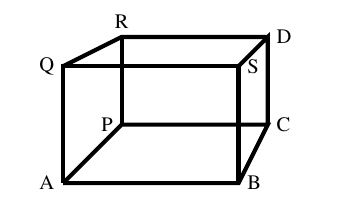
Let the dimensions of the base be $x$ metres and $y$ metres, the total expenses be Rs. $S$ and the volume of the tank be $V m^3$, then
$V = 2xy \Rightarrow 8 = 2xy \Rightarrow y = \cfrac{4}{x}$ …(i)Also, area of the base $= xy = x \times \cfrac{4}{x} = 4 m^2$ (from (i))
and total area of the four sides $= (2x + 2x + 2y + 2y) m^2$
$ = \left( 4x + 4\left( \cfrac{4}{x} \right) \right) m^2$ (from (i))
$ = 4\left\{ x + \cfrac{4}{x} \right\} m^2$$\therefore $ $S = 4 \times 70 + 45 \times 4\left\{ x + \cfrac{4}{x} \right\} = 280 + 180\left\{ x + \cfrac{4}{x} \right\}$ …(ii)
Differentiating (ii) w.r.t. $x$, we get $\cfrac{dS}{dx} = 180\left( 1 – \cfrac{4}{x^2} \right)$ …(iii)
For maximum/minimum expenses, $\cfrac{dS}{dx} = 0$
$ \Rightarrow 180\left( 1 – \cfrac{4}{x^2} \right) = 0 \Rightarrow x^2 = 4 \Rightarrow x = 2$Differentiating (iii) w.r.t. $x$, we get $\cfrac{d^2 S}{dx^2} = 180\left( 0 + \cfrac{8}{x^3} \right) = \cfrac{1440}{x^3}$ …(iv)
Now ${\left( \cfrac{d^2 S}{dx^2} \right)}_{x = 2} = \cfrac{1440}{2^3} > 0$
$\therefore $ $S$ is least when $x = 2$.Thus, cost of least expensive tank $= Rs.\left\{ 280 + 180\left( 2 + \cfrac{4}{2} \right) \right\}$ (from (ii)) $= Rs.(280 + 720) = Rs. 1000$
-
The sum of the perimeter of a circle and square is $k$, where $k$ is some constant. Prove that the sum of their areas is least when the side of square is double the radius of the circle.
SOLUTION
Let $r$ be the radius of the circle and $x$ be the side of the square, then $2\pi r + 4x = k$. …(i)
Let $S$ be the sum of areas of the circle and the square, then
$S = \pi r^2 + x^2 = \pi r^2 + \left( \cfrac{k – 2\pi r}{4} \right)^2$ (from (i) $x = \cfrac{k – 2\pi r}{4}$)
$ = \pi r^2 + \cfrac{k^2}{16} + \cfrac{\pi^2 r^2}{4} – \cfrac{k\pi r}{4}$. …(ii)Differentiating (ii) w.r.t. $r$, we get $\cfrac{dS}{dr} = 2\pi r + \cfrac{2\pi^2 r}{4} – \cfrac{k\pi}{4}$ …(iii)
For maximum/minimum $S$, $\cfrac{dS}{dr} = 0$
$ \Rightarrow 2\pi r + \cfrac{2\pi^2 r}{4} – \cfrac{k\pi}{4} = 0 \Rightarrow r\left( 2\pi + \cfrac{\pi^2}{2} \right) = \cfrac{k\pi}{4}$
$ \Rightarrow r = \cfrac{2k\pi}{4(4\pi + \pi^2)} = \cfrac{k}{2(4 + \pi)}$Differentiating (iii) w.r.t. $r$, we get $\cfrac{d^2 S}{dr^2} = 2\pi + \cfrac{\pi^2}{2} > 0 \forall r.$
So, ${\left( \cfrac{d^2 S}{dr^2} \right)}_{r = \cfrac{k}{2(4 + \pi)}} > 0 \Rightarrow S$ is minimum at $r = \cfrac{k}{2(4 + \pi)}$
$ \Rightarrow x = \cfrac{1}{4}\left\{ k – \cfrac{2\pi}{2}\left( \cfrac{k}{4 + \pi} \right) \right\}$ (from (i))$ = \cfrac{4k}{4(4 + \pi)} = 2\left[ \cfrac{2k}{4(4 + \pi)} \right] = 2\left[ \cfrac{k}{2(4 + \pi)} \right] = 2r$
Hence, $S$ is least when side of the square is double the radius of the circle.
-
A window is in the form of a rectangle surmounted by a semicircular opening. The total perimeter of the window is $10 m$. Find the dimensions of the window to admit maximum light through the whole opening.
SOLUTION
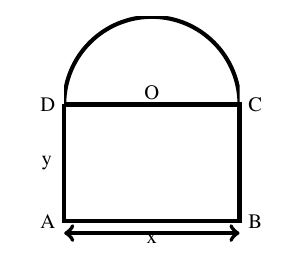
Let $x$ and $y$ be respectively the length and breadth of the rectangle.
Radius of the semi-circle $= \cfrac{x}{2}$
Circumference of the circular part $= \cfrac{\pi x}{2}$Perimeter of the window $= x + 2y + \cfrac{\pi x}{2} = 10$ (Given)
$ \Rightarrow 2x + 4y + \pi x = 20 \Rightarrow y = \cfrac{20 – (2 + \pi)x}{4}$ …(i)
Area of the window $= \text{area of rectangle} + \text{area of semi-circle}$
$A = xy + \cfrac{1}{2}\pi \left( \cfrac{x}{2} \right)^2 = x\left( \cfrac{20 – (2 + \pi)x}{4} \right) + \cfrac{\pi x^2}{8}$ (from (i))
$ \Rightarrow A = \cfrac{20x – (2 + \pi)x^2}{4} + \cfrac{\pi x^2}{8}$
$ \Rightarrow \cfrac{dA}{dx} = \cfrac{20 – (2 + \pi)2x}{4} + \cfrac{2\pi x}{8}$For maxima/minima $A$, $\cfrac{dA}{dx} = 0$
$ \Rightarrow \cfrac{20 – (2 + \pi)2x}{4} + \cfrac{2\pi x}{8} = 0$
$ \Rightarrow 20 – (2 + \pi)2x + \pi x = 0 \Rightarrow 20 + x(\pi – 4 – 2\pi) = 0$
$ \Rightarrow 20 – x(4 + \pi) = 0 \Rightarrow x = \cfrac{20}{4 + \pi}$$\cfrac{d^2 A}{dx^2} = \cfrac{-(2 + \pi)2}{4} + \cfrac{2\pi}{8} = \cfrac{-4 – 2\pi + \pi}{4} = \cfrac{-4 – \pi}{4} \Rightarrow \cfrac{d^2 A}{dx^2} < 0 \forall x$
Hence, the window admits the maximum light, when
$x = \text{length} = \cfrac{20}{4 + \pi} m$$\therefore $ breadth $y = \cfrac{20 – (2 + \pi)\cfrac{20}{4 + \pi}}{4} = \cfrac{80 + 20\pi – 40 – 20\pi}{4(4 + \pi)}$
$ = \cfrac{40}{4(4 + \pi)} = \cfrac{10}{4 + \pi} m$ -
A point on the hypotenuse of a right triangle is at distances $a$ and $b$ from the sides of the triangle. Show that the minimum length of the hypotenuse is $(a^{2/3} + b^{2/3})^{3/2}$.
SOLUTION
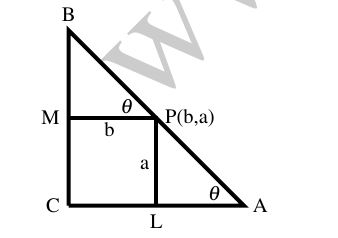
Let $ABC$ be a right triangle with hypotenuse $AB$.
Let $P$ be on $AB$ such that $PL = a$ and $PM = b$. Let $\angle CAB = \theta$.
$\therefore $ $AP = a \csc \theta$ and $BP = b \sec \theta$.If $l$ be the length of the hypotenuse $AB$, then
$l = AP + BP = a \csc \theta + b \sec \theta$.$\cfrac{dl}{d\theta} = -a \csc \theta \cot \theta + b \sec \theta \tan \theta$
For maximum/minimum, $\cfrac{dl}{d\theta} = 0$
$ \Rightarrow -a \csc \theta \cot \theta + b \sec \theta \tan \theta = 0$
$ \Rightarrow -\cfrac{a\cos \theta}{\sin^2 \theta} + \cfrac{b\sin \theta}{\cos^2 \theta} = 0 \Rightarrow \cfrac{a\cos \theta}{\sin^2 \theta} = \cfrac{b\sin \theta}{\cos^2 \theta}$
$ \Rightarrow \tan^3 \theta = \cfrac{a}{b} \Rightarrow \tan \theta = \left( \cfrac{a}{b} \right)^{1/3}$$\therefore $ $\sin \theta = \cfrac{a^{1/3}}{\sqrt{a^{2/3} + b^{2/3}}}$ and $\cos \theta = \cfrac{b^{1/3}}{\sqrt{a^{2/3} + b^{2/3}}}$
Now, $\cfrac{d^2 l}{d\theta^2} = a \csc^3 \theta + a \csc \theta \cot^2 \theta + b \sec^3 \theta + b \sec \theta \tan^2 \theta$
and $\cfrac{d^2 l}{d\theta^2} > 0$ when $\tan \theta = \left( \cfrac{a}{b} \right)^{1/3}$Thus, $l$ is minimum when $\tan \theta = \left( \cfrac{a}{b} \right)^{1/3}$
$\therefore $ Minimum value of $l = a\sqrt{1 + \cot^2 \theta} + b\sqrt{1 + \tan^2 \theta}$
$ = a\sqrt{1 + \left( \cfrac{b}{a} \right)^{2/3}} + b\sqrt{1 + \left( \cfrac{a}{b} \right)^{2/3}}$$ = a^{2/3}\sqrt{a^{2/3} + b^{2/3}} + b^{2/3}\sqrt{b^{2/3} + a^{2/3}} = (a^{2/3} + b^{2/3})^{3/2}$
-
Find the points at which the function $f$ given by $f(x) = (x – 2)^4 (x + 1)^3$ has
(i) local maxima
(ii) local minima
(iii) point of inflexion.SOLUTION
We have: $f(x) = (x – 2)^4 (x + 1)^3$
$f'(x) = (x – 2)^4 \cdot 3(x + 1)^2 + (x + 1)^3 \cdot 4(x – 2)^3$$ = (x – 2)^3 (x + 1)^2 [3(x – 2) + 4(x + 1)]$
$ = (x – 2)^3 (x + 1)^2 (7x – 2) = 7(x – 2)^3 (x + 1)^2 \left( x – \cfrac{2}{7} \right)$For maximum/minimum, $f'(x) = 0$
$ \Rightarrow 7(x – 2)^3 (x + 1)^2 \left( x – \cfrac{2}{7} \right) = 0 \Rightarrow x = 2, -1, \cfrac{2}{7}$(ii) When $x < 2$ (slightly), $f'(x) = (-)(+)(+) = -ve$
When $x > 2$ (slightly), $f'(x) = (+)(+)(+) = +ve$
$\therefore $ $f'(x)$ changes its sign from $-ve$ to $+ve$ when passing through the point $x = 2$. Thus, $f$ has local minima at $x = 2$.(iii) When $x < -1$ (slightly), $f'(x) = (-)(+)(-) = +ve$
When $x > -1$ (slightly), $f'(x) = (-)(+)(-) = +ve$
$\therefore $ $f'(x)$ does not change its sign when passing through the point $x = -1$. Thus, $x = -1$ is a point of inflexion.(i) When $x < \cfrac{2}{7}$ (slightly), $f'(x) = (-)(+)(-) = +ve$
When $x > \cfrac{2}{7}$ (slightly), $f'(x) = (-)(+)(+) = -ve$
$\therefore $ $f'(x)$ changes its sign from $+ve$ to $-ve$ when passing through the point $x = \cfrac{2}{7}$. Thus, $f(x)$ has local maxima at $x = \cfrac{2}{7}$. -
Find the absolute maximum and minimum values of the function $f$ given by $f(x) = \cos^2 x + \sin x$, $x \in [0, \pi]$.
SOLUTION
We have, $f(x) = \cos^2 x + \sin x$, $x \in [0, \pi]$
$\therefore $ $f'(x) = 2\cos x(-\sin x) + \cos x = \cos x(-2\sin x + 1)$For maximum/minimum values, $f'(x) = 0$
$ \Rightarrow \cos x(-2\sin x + 1) = 0 \Rightarrow \cos x = 0$, or $-2\sin x + 1 = 0$
$ \Rightarrow x = \cfrac{\pi}{2}$ or $\sin x = \cfrac{1}{2} \Rightarrow x = \cfrac{\pi}{6}, \cfrac{5\pi}{6}$For absolute maximum and minimum values of $f(x)$, we evaluate $f(0), f(\pi), f(\pi/2), f(\pi/6), f(5\pi/6)$
Now $f(0) = \cos^2 0 + \sin 0 = 1 + 0 = 1,$$f\left( \cfrac{\pi}{6} \right) = \cos^2 \cfrac{\pi}{6} + \sin \cfrac{\pi}{6} = \left( \cfrac{\sqrt{3}}{2} \right)^2 + \cfrac{1}{2} = \cfrac{3}{4} + \cfrac{1}{2} = \cfrac{5}{4},$
$f\left( \cfrac{5\pi}{6} \right) = \cos^2 \left( \cfrac{5\pi}{6} \right) + \sin \left( \cfrac{5\pi}{6} \right) = \left( -\cfrac{\sqrt{3}}{2} \right)^2 + \cfrac{1}{2} = \cfrac{3}{4} + \cfrac{1}{2} = \cfrac{5}{4}$
$f\left( \cfrac{\pi}{2} \right) = \cos^2 \cfrac{\pi}{2} + \sin \cfrac{\pi}{2} = 0 + 1 = 1$ and
$f(\pi) = \cos^2 \pi + \sin \pi = (-1)^2 + 0 = 1.$Hence, absolute maximum and minimum values are $\cfrac{5}{4}$ and $1$ respectively.
-
Show that the altitude of the right circular cone of maximum volume that can be inscribed in a sphere of radius $r$ is $\cfrac{4r}{3}$.
SOLUTION
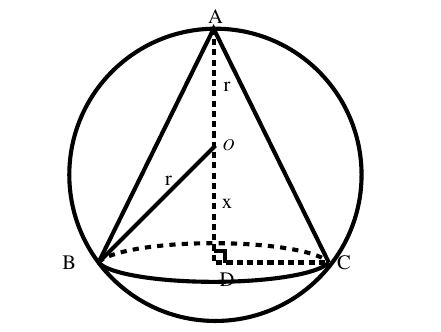
Let the distance of the base $BC$ of the cone $ABC$ from the centre $O$ of the sphere be $x$. Radius of the sphere is $r$.
Altitude of the cone, $H = AD = r + x$
and radius of the base of cone, $R = BD = \sqrt{r^2 – x^2}$$\therefore $ The volume of the cone,
$V = \cfrac{1}{3}\pi R^2 H$
$ \Rightarrow V = \cfrac{1}{3}\pi (r^2 – x^2)(r + x)$
$\therefore $ $\cfrac{dV}{dx} = \cfrac{\pi}{3}[(r^2 – x^2)(0 + 1) + (r + x)(0 – 2x)]$
$ = \cfrac{\pi}{3}[(r – x)(r + x) – 2x(r + x)]$
$ = \cfrac{\pi}{3}[(r + x)(r – x – 2x)] = \cfrac{\pi}{3}(r + x)(r – 3x)$For maximum/minimum volume, $\cfrac{dV}{dx} = 0 \Rightarrow \cfrac{\pi}{3}(r + x)(r – 3x) = 0$
$ \Rightarrow (r + x)(r – 3x) = 0 \Rightarrow x = -r, \cfrac{r}{3}$.
But $x \ne -r$, $\therefore x = \cfrac{r}{3}$.Now, $\cfrac{d^2 V}{dx^2} = \cfrac{\pi}{3}[(r + x)(-3) + (r – 3x)(1)]$
$ = \cfrac{\pi}{3}(-3r – 3x + r – 3x) = \cfrac{\pi}{3}(-2r – 6x)$$\therefore $ ${\left( \cfrac{d^2 V}{dx^2} \right)}_{x = \cfrac{r}{3}} = \cfrac{\pi}{3}\left[ -2r – 6\left( \cfrac{r}{3} \right) \right] = \cfrac{\pi}{3}(-2r – 2r) = -\cfrac{4r\pi}{3} < 0$
Hence, $V$ is maximum when $x = \cfrac{r}{3}$ and
the altitude $= r + x = r + \cfrac{r}{3} = \cfrac{4r}{3}$. -
Let $f$ be a function defined on $[a, b]$ such that $f'(x) > 0$, for all $x \in (a, b)$. Then, prove that $f$ is an increasing function on $(a, b)$.
SOLUTION
Let $x_1, x_2 \in (a, b)$ such that $x_1 < x_2$.
Let the sub-interval be $[x_1, x_2]$.Since $f(x)$ is differentiable on $(a, b)$ and $[x_1, x_2] \subset (a, b)$
$\therefore $ $f(x)$ is continuous in $[x_1, x_2]$ and differentiable in $(x_1, x_2)$.
$\therefore $ By L.M.V. theorem, there exists $c \in (x_1, x_2)$ such that $f'(c) = \cfrac{f(x_2) – f(x_1)}{x_2 – x_1}$Now, $f'(x) > 0$ for all $x \in (a, b) \Rightarrow f'(c) > 0$
$ \Rightarrow \cfrac{f(x_2) – f(x_1)}{x_2 – x_1} > 0 \Rightarrow f(x_2) – f(x_1) > 0$
$ \Rightarrow f(x_1) < f(x_2)$ if $x_1 < x_2$Hence, $f$ is increasing in $(a, b)$. [are arbitrary]
-
Show that the height of the cylinder of maximum volume that can be inscribed in a sphere of radius $R$ is $\cfrac{2R}{\sqrt{3}}$. Also, find the maximum volume.
SOLUTION
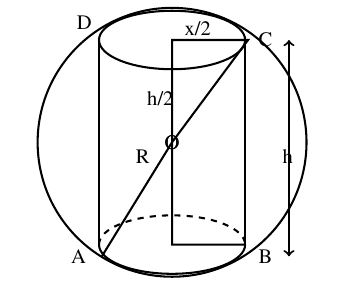
Let $h$ be the height and $x$ the diameter of the base of the inscribed cylinder.
Then in $\Delta ABC$, $h^2 + x^2 = 4R^2$ …(i)
Now, the volume of the cylinder $V = \pi \left( \cfrac{x}{2} \right)^2 h = \cfrac{1}{4}\pi x^2 h$$ \Rightarrow V = \cfrac{1}{4}\pi (4R^2 – h^2)h$ [from (i)]
$ \Rightarrow V = \pi R^2 h – \cfrac{1}{4}\pi h^3 \Rightarrow \cfrac{dV}{dh} = \pi R^2 – \cfrac{3}{4}\pi h^2 = \pi \left( R^2 – \cfrac{3}{4}h^2 \right)$For maxima/minima of volume, $\cfrac{dV}{dh} = 0$
$ \Rightarrow \pi \left( R^2 – \cfrac{3}{4}h^2 \right) = 0 \Rightarrow R^2 = \cfrac{3}{4}h^2 \Rightarrow h = \cfrac{2R}{\sqrt{3}}$Also $\cfrac{d^2 V}{dh^2} = -\cfrac{3}{4}\pi (2h) = -\cfrac{3}{2}\pi h$
and ${\left( \cfrac{d^2 V}{dx^2} \right)}_{h = \cfrac{2R}{\sqrt{3}}} = -\cfrac{3}{2}\pi \left( \cfrac{2R}{\sqrt{3}} \right) < 0$Thus, $V$ is maximum at $h = \cfrac{2R}{\sqrt{3}}$ and maximum volume
$ = \cfrac{1}{4}\pi \left( \cfrac{2R}{\sqrt{3}} \right) \left( 4R^2 – \cfrac{4R^2}{3} \right) = \cfrac{\pi R}{2\sqrt{3}} \left( \cfrac{8R^2}{3} \right) = \cfrac{4\pi R^3}{3\sqrt{3}}$ cubic units. -
Show that height of the cylinder of greatest volume which can be inscribed in a right circular cone of height $h$ and semi vertical angle $\alpha$ is one-third that of the cone and the greatest volume of cylinder is $\cfrac{4}{27}\pi h^3 \tan^2 \alpha$.
SOLUTION
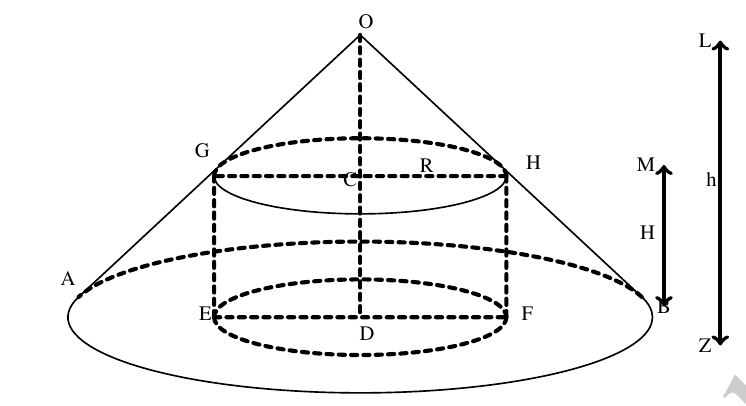
Let $R$ be the radius, $H$ be the height of the cylinder inscribed in a cone of radius $r$ and height $h$.
Then, $OC = OE – CE = h – H$ and $CD = R$.
Now, in $\Delta OCD$, $\tan \alpha = \cfrac{CD}{OC} = \cfrac{R}{h – H}$
$ \Rightarrow R = (h – H)\tan \alpha$
where $\alpha$ is the semi-vertical angle of the coneAs $\alpha$ is given. $\therefore $ It is constant.
$\therefore $ The volume of the cylinder,
$V = \pi R^2 H = \pi [(h – H)^2 \tan^2 \alpha] H$ [Using (i)]
$V = \pi H (h – H)^2 \tan^2 \alpha$ …(ii)Differentiating (ii) w.r.t $H$, we get
$\cfrac{dV}{dH} = \pi [(h – H)^2 \times 1 + H \cdot 2(h – H)(-1)]\tan^2 \alpha$
$ = \pi \tan^2 \alpha [(h – H)^2 – 2H(h – H)]$
$ = \pi \tan^2 \alpha (h^2 – 2hH + H^2 – 2hH + 2H^2)$
$ = \pi \tan^2 \alpha (h^2 – 4hH + 3H^2) = \pi \tan^2 \alpha (h – H)(h – 3H)$For maximum volume, $\cfrac{dV}{dH} = 0 \Rightarrow (h – H)(h – 3H) = 0$
$ \Rightarrow h = H$ or $3H = h$ i.e., $H = \cfrac{h}{3}$.
Clearly $H \ne h$ [Cylinder is inscribed in the cone]
Hence, $H = \cfrac{h}{3}$.Also, $\cfrac{d^2 V}{dH^2} = \pi \tan^2 \alpha (0 – 4h + 6H)$
and ${\left( \cfrac{d^2 V}{dH^2} \right)}_{H = \cfrac{h}{3}} = \pi \tan^2 \alpha \left( -4h + 6\left( \cfrac{h}{3} \right) \right) = \pi \tan^2 \alpha (-2h) < 0.$Hence, the volume of the inscribed cylinder is maximum when its height is $\cfrac{h}{3}$.
Radius of the cylinder $R = CD = OC \tan \alpha = (h – H)\tan \alpha$
$ = \left( h – \cfrac{h}{3} \right)\tan \alpha = \cfrac{2}{3}h \tan \alpha$$\therefore $ Volume of the cylinder $ = \pi \left( \cfrac{2}{3}h \tan \alpha \right)^2 \left( \cfrac{h}{3} \right) = \cfrac{4}{27}\pi h^3 \tan^2 \alpha.$
Choose the correct answer in the Exercises from 19 to 24.
-
A cylindrical tank of radius $10m$ is being filled with wheat at the rate of $314$ cubic metres per hour. Then the depth of the wheat is increasing at the rate of
(A) $1 m/h$
(B) $0.1 m/h$
(C) $1.1 m/h$
(D) $0.5 m/h$SOLUTION
(A): Let $h$ be the depth of the cylindrical tank.
$\therefore $ The volume of cylindrical tank $V = \pi r^2 h = \pi (10)^2 h = 100\pi h$Differentiating with respect to $t$, we get
Rate of change of volume, $\cfrac{dV}{dt} = 100\pi \cfrac{dh}{dt}$ …(i)
$ \Rightarrow 314 = 100\pi \cfrac{dh}{dt}$ $\left[ \cfrac{dV}{dt} = 314 \text{ (given)} \right]$
$ \Rightarrow \cfrac{dh}{dt} = \cfrac{314}{100\pi} = \cfrac{314}{100 \times 3.14} = \cfrac{314}{314} = 1 m/h$ -
The slope of the tangent to the curve $x = t^2 + 3t – 8, y = 2t^2 – 2t – 5$ at the point $(2, -1)$ is
(A) $\cfrac{22}{7}$
(B) $\cfrac{6}{7}$
(C) $\cfrac{7}{6}$
(D) $\cfrac{-6}{7}$SOLUTION
(B): We have, $x = t^2 + 3t – 8$ and $y = 2t^2 – 2t – 5$ …(i)
At $(2, -1)$, $2 = t^2 + 3t – 8 \Rightarrow t^2 + 3t – 10 = 0$
$ \Rightarrow (t + 5)(t – 2) = 0 \Rightarrow t = 2, -5$
and $-1 = 2t^2 – 2t – 5 \Rightarrow 2t^2 – 2t – 4 = 0 \Rightarrow 2(t – 2)(t + 1) = 0$
$ \Rightarrow t = 2, -1$Thus, at $x = 2$ and $y = -1$, $t = 2$.
Differentiating (i) w.r.t. $t$, $\cfrac{dx}{dt} = 2t + 3$ and $\cfrac{dy}{dt} = 4t – 2$$ \Rightarrow \cfrac{dy}{dx} = \cfrac{dy/dt}{dx/dt} = \cfrac{4t – 2}{2t + 3}$
$\therefore $ ${\left( \cfrac{dy}{dx} \right)}_{t = 2} = \cfrac{4(2) – 2}{2(2) + 3} = \cfrac{6}{7}$ -
The line $y = mx + 1$ is a tangent to the curve $y^2 = 4x$ if the value of $m$ is
(A) $1$
(B) $2$
(C) $3$
(D) $1/2$SOLUTION
(A): We have, $y^2 = 4x$ …(i)
Differentiating (i) w.r.t. $x$, we get $2y \cfrac{dy}{dx} = 4 \Rightarrow \cfrac{dy}{dx} = \cfrac{2}{y}$
Now, ${\left( \cfrac{dy}{dx} \right)}_{(x_1, y_1)} = \cfrac{2}{y_1} = m$ (say) …(ii)Let $(x_1, y_1)$ be any point on (i), then $y_1^2 = 4x_1$ …(iii)
$\therefore $ The equation of tangent is
$y – y_1 = m(x – x_1) \Rightarrow y = mx + y_1 – m x_1$ …(iv)We have equation of tangent to curve $y^2 = 4x$ as $y = mx + 1$
$ \Rightarrow mx + 1 = mx + y_1 – m x_1 \Rightarrow y_1 – m x_1 = 1$ …(v)Also, $m = \cfrac{2}{y_1}$, $x_1 = \cfrac{y_1^2}{4}$ [By (ii) and (iii)]
Putting these values in (v) we get,
$y_1 – \cfrac{2}{y_1} \times \cfrac{y_1^2}{4} = 1 \Rightarrow y_1 – \cfrac{y_1}{2} = 1 \Rightarrow \cfrac{y_1}{2} = 1 \Rightarrow y_1 = 2$
$\therefore $ $m = \cfrac{2}{y_1} = \cfrac{2}{2} = 1$ -
The normal at the point $(1,1)$ on the curve $2y + x^2 = 3$ is
(A) $x + y = 0$
(B) $x – y = 0$
(C) $x + y + 1 = 0$
(D) $-x + y + 2 = 0$SOLUTION
(B): We have, $2y + x^2 = 3$ …(i)
Differentiating (i) w.r.t. $x$, we get $2\cfrac{dy}{dx} + 2x = 0 \Rightarrow \cfrac{dy}{dx} = -x$
As, ${\left( \cfrac{dy}{dx} \right)}_{(1,1)} = -1$. $\therefore $ Slope of normal $= 1$
The equation of normal is $y – 1 = 1 \cdot (x – 1) \Rightarrow x – y = 0.$
-
The normal to the curve $x^2 = 4y$ passing $(1,2)$ is
(A) $x + y = 3$
(B) $x – y = 3$
(C) $x + y = 1$
(D) $x – y = 1$SOLUTION
(A) We have $x^2 = 4y$ …(i)
Let $(x_1, y_1)$ be any point on (i),
$\therefore $ $x_1^2 = 4y_1$ …(ii)
Differentiating (i) w.r.t. $x$, we get $2x = 4\cfrac{dy}{dx} \Rightarrow \cfrac{dy}{dx} = \cfrac{x}{2}.$So, slope of the normal at $(x_1, y_1) = -\cfrac{2}{x_1}$
$\therefore $ The equation of normal is $y – y_1 = -\cfrac{2}{x_1}(x – x_1)$ …(iii)Since it passes through $(1,2)$, $\therefore $ $2 – y_1 = -\cfrac{2}{x_1}(1 – x_1)$
$ \Rightarrow 2x_1 – x_1 y_1 = -2 + 2x_1 \Rightarrow x_1 y_1 = 2 \Rightarrow y_1 = \cfrac{2}{x_1}$Putting $y_1 = \cfrac{2}{x_1}$ in (ii), $x_1^2 = 4 \cdot \cfrac{2}{x_1} \Rightarrow x_1^3 = 8 \Rightarrow x_1 = 2$
$\therefore $ $y_1 = \cfrac{2}{2} = 1.$Putting $x_1 = 2, y_1 = 1$ in (iii), then the equation of the normal is
$y – 1 = -\cfrac{2}{2}(x – 2) \Rightarrow y – 1 = -x + 2 \Rightarrow x + y = 3.$ -
The points on the curve $9y^2 = x^3$, where the normal to the curve makes equal intercepts with the axes are
(A) $\left(4, \pm \cfrac{8}{3}\right)$
(B) $\left(4, \cfrac{-8}{3}\right)$
(C) $\left(4, \pm \cfrac{3}{8}\right)$
(D) $\left(\pm 4, \cfrac{3}{8}\right)$SOLUTION
(A) We have, $9y^2 = x^3$ …(i)
Differentiating (i) w.r.t. $x$, we get $18y \cfrac{dy}{dx} = 3x^2 \Rightarrow \cfrac{dy}{dx} = \cfrac{x^2}{6y}$Let $P(x_1, y_1)$ be the point on (i).
$\therefore $ $9y_1^2 = x_1^3$ …(ii)Now, slope of tangent at $(x_1, y_1)$ is $\cfrac{x_1^2}{6y_1}$
Slope of normal at $(x_1, y_1)$ is $-\cfrac{6y_1}{x_1^2}$Since the normal makes equal intercepts on the axes, [Given]
$\therefore $ Its slope $= \pm 1 \Rightarrow \cfrac{6y_1}{x_1^2} = \pm 1$
$ \Rightarrow 6y_1 = \pm x_1^2$ …(iii)Now from (ii) and (iii), we get $9\left( \cfrac{x_1^2}{6} \right)^2 = x_1^3$
$ \Rightarrow \cfrac{x_1^4}{4} = x_1^3 \Rightarrow x_1 = 4$Putting $x_1 = 4$ in (iii), $y_1 = \pm \cfrac{x_1^2}{6} = \pm \cfrac{16}{6} = \pm \cfrac{8}{3}$
Hence, the points are $\left(4, \pm \cfrac{8}{3}\right)$.
Frequently Asked Questions (FAQs)
How can students master application of derivatives concepts effectively in Class 12 Maths?
NCERT Solutions for Class 12 Maths Chapter 6 Application of Derivatives helps students understand rate of change, tangents, and maxima-minima concepts clearly. Moreover, step-by-step explanations improve logical understanding. Students can explore structured study material at www.mathstudy.in and access additional free academic support at udgamwelfarefoundation.com for better preparation.
Where can I download chapter-wise application of derivatives solutions for offline revision?
Students looking for organized study material can download NCERT Solutions for Class 12 Maths Chapter 6 Application of Derivatives PDF for structured revision and offline practice. Therefore, preparation becomes easier. Educational platforms like mathstudy.in and udgamwelfarefoundation.com regularly provide updated academic resources.
How does HOTS question bank help in solving application of derivatives problems?
HOTS question bank strengthens analytical thinking and improves problem solving ability in derivatives applications. In addition, it prepares students for complex board exam questions. Students can purchase the ebook from HOTS Important Questions Mathematics Class 12 for advanced and structured preparation.
Why should students use free online learning platforms for application of derivatives chapter?
Free online learning platforms provide structured and accessible academic support for Class 12 students. Moreover, they reduce dependency on expensive coaching materials. Therefore, platforms like mathstudy.in and udgamwelfarefoundation.com help students prepare consistently and improve exam performance.