
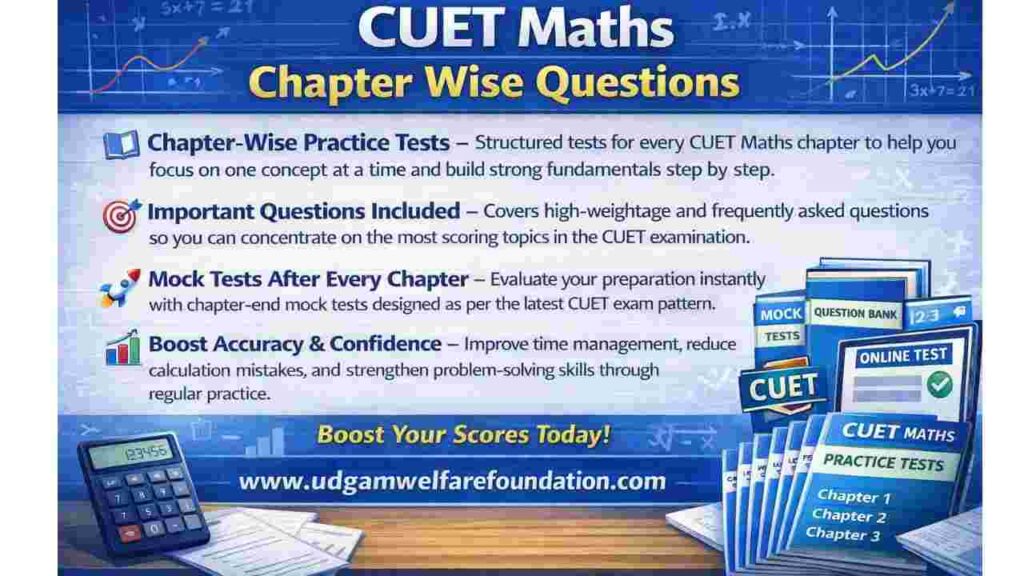
Structured Preparation for CUET Mathematics
CUET Maths Chapter Wise Questions PDF helps students prepare systematically by dividing the syllabus into manageable sections. It ensures focused practice for every chapter. Moreover, learners can identify weak areas quickly and improve conceptual clarity. As a result, preparation becomes more organized and efficient.
Improve Accuracy and Exam Performance
CUET Maths Chapter Wise Questions PDF supports consistent revision and structured practice. Therefore, students strengthen problem-solving techniques step by step. Additionally, practicing chapter-wise questions improves time management skills. Consequently, learners gain confidence and perform better in the actual CUET examination.
Comprehensive Chapter Wise Practice Resources
Students can enhance preparation using CUET Maths Chapter Wise Practice Questions for targeted revision. Furthermore, CUET Maths Important Questions Chapter Wise highlight high-weightage areas. CUET Maths Topic Wise Questions PDF strengthens individual concepts effectively. Additionally, CUET Maths Previous Year Chapter Wise Questions improve exam familiarity. Practicing with CUET Maths Chapter Wise Mock Test and CUET Maths Chapter Wise Question Bank PDF ensures deeper understanding. Moreover, CUET Maths Chapter Wise MCQs enhance speed and accuracy. Finally, CUET Maths Chapter Wise Test Series and CUET Maths Chapter Wise Solved Questions PDF provide complete preparation support.
CUET Mathematics: Full Syllabus Test Papers
Free chapter-wise practice questions for Section A1, B1, and B2.
1. Algebra (Matrices & Determinants)
Algebra focuses on the systematic study of matrices and their operational properties. Candidates must understand types of matrices, equality conditions, and the significance of the transpose. Mastery of symmetric and skew-symmetric matrices is required, alongside the algebra of matrices. The unit covers determinants, calculating the inverse of a matrix, and the application of matrix methods to solve simultaneous linear equations accurately.
Take Chapter Test2. Calculus
Calculus in Section A1 emphasizes the behavior and optimization of functions. It includes finding higher-order derivatives, specifically second-order derivatives, to understand curvature. Students will analyze increasing and decreasing functions to determine intervals of monotonicity. The most critical application is finding maxima and minima, which helps in solving real-world optimization problems where identifying peak efficiency or lowest cost is necessary for success.
Take Chapter Test3. Integration and its Applications
This unit introduces the concepts of anti-derivatives and spatial measurement. It starts with the indefinite integrals of simple functions and the systematic evaluation of indefinite integrals. Transitioning to definite integrals, the course focuses on calculating numerical values within boundaries. A major application is using integration to find the area under a curve, specifically for simple curves, providing a geometric understanding of accumulated totals over time.
Take Chapter Test4. Differential Equations
Differential equations describe relationships between variables and their rates of change. Students must be able to identify the order and degree of differential equations to classify them correctly. The curriculum focuses on solving differential equations with the variables separable method, which is a fundamental technique for finding general solutions. Understanding these concepts is essential for modeling growth and decay processes in physics and chemistry contexts within the exam.
Take Chapter Test5. Probability Distributions
Probability distributions provide the framework for analyzing random events in a structured manner. The central concept here is the random variable, which assigns numerical outcomes to random experiments. Students will learn how to map these variables to their respective probabilities to predict long-term patterns. This chapter forms the basis for statistical reasoning, helping students evaluate likelihoods and expectancies in complex scenarios frequently encountered in the CUET quantitative sections.
Take Chapter Test6. Linear Programming
Linear Programming (LPP) is an optimization technique used to achieve the best outcome under constraints. Students will master the graphical method of solution for two-variable problems. This includes identifying the feasible and infeasible regions based on a set of linear inequalities. The ultimate objective is to find the optimal feasible solution that satisfies all constraints while maximizing or minimizing the objective function, which is a vital skill for resource management problems.
Take Chapter TestUnit I: Relations and Functions
This unit explores the logical connection between sets and their elements. It covers types of relations including reflexive, symmetric, and transitive, leading to equivalence relations. Students must differentiate between one-one (injective) and onto (surjective) functions. Furthermore, it delves into Inverse Trigonometric Functions, focusing on their domain, range, principal values, and the interpretation of their graphs, which is essential for solving advanced trigonometric problems.
Take Chapter TestUnit II: Algebra (Core)
The Core Algebra unit deepens the understanding of Matrices and Determinants. Topics include matrix notation, zero matrices, and non-commutativity of multiplication. It covers invertible matrices and the uniqueness of inverse. For Determinants, students learn to calculate up to 3×3 matrices, utilize minors and cofactors, find the area of a triangle, and apply the adjoint and inverse to solve systems of linear equations in two or three variables efficiently.
Take Chapter Test Take Chapter TestUnit III: Calculus (Detailed)
This comprehensive calculus unit covers Continuity and Differentiability using the Chain Rule, and derivatives of inverse trigonometric, logarithmic, and exponential functions. It explores logarithmic, parametric, and implicit differentiation. Techniques of integration involve substitution, partial fractions, and integration by parts. Students also study applications like rate of change and area under standard curves like circles, parabolas, and ellipses, alongside solving homogeneous and linear differential equations.
Take Chapter Test Take Chapter Test Take Chapter Test Take Chapter Test Take Chapter TestUnit IV: Vectors and 3D Geometry
Vector algebra involves the study of dot and cross products and their physical interpretations. In 3D Geometry, students focus on direction cosines and ratios to define lines in space. The unit covers the equation of a line in Cartesian and vector forms. Key concepts include finding the angle between two lines and the shortest distance between skew lines, which are fundamental for understanding three-dimensional spatial orientation and geometry problems.
Take Chapter TestUnit V: Linear Programming
Focusing on optimization, this unit requires students to define constraints and objective functions for a given problem. Using the graphical solution method, students must visualize feasible and infeasible regions to pinpoint the optimal solution. This systematic approach allows for the maximization of profit or minimization of cost within the boundaries of linear inequalities, a core requirement for candidates aiming for high scores in the analytical sections of the exam.
Take Chapter TestUnit VI: Probability
Core Probability involves complex decision-making theories. It starts with conditional probability and the multiplication theorem for finding the likelihood of combined events. A major highlight is Baye’s theorem, which is essential for calculating posterior probabilities. The unit concludes with the study of random variables, ensuring students can handle multi-step probability problems that involve dependent and independent events commonly found in the CUET mathematics paper.
Take Chapter TestUnit I: Numbers & Numerical Applications
Applied Mathematics starts with Modulo arithmetic and congruence modulo, vital for theoretical and computer logic. It includes practical competitive topics like Allegation and mixture, Boats and streams, and Pipes and cisterns. Students will also master Races and games and solve numerical inequalities. This unit is designed to enhance numerical speed and the ability to apply mathematical logic to common real-life scenarios and competitive entrance test problems.
Take Chapter TestUnit II: Algebra (Applied)
In the Applied stream, Algebra focuses on the utility of matrices and determinants in business and data analysis. This includes matrix operations and finding the inverse of a matrix to solve systems of equations involving up to three variables. This unit ensures students can handle multivariate data and solve for unknown factors in a systematic, matrix-driven approach, which is a standard requirement for data-centric professional fields.
Take Chapter TestUnit III: Calculus (Applied)
Applied Calculus connects mathematical change to economics. It covers higher-order derivatives alongside economic concepts like Marginal cost and Marginal revenue. Students will use maxima and minima to find optimal business points. The unit also introduces indefinite and definite integrals to calculate Consumer and producer surplus. Additionally, it explores differential equations specifically through growth and decay models, which are used to predict population trends and financial fluctuations.
Take Chapter TestUnit IV: Probability Distributions (Applied)
This unit expands on statistical distributions used in research. It covers random variables and mathematical expectation, which represents the average outcome. Students will calculate variance and standard deviation to measure data spread. The course details specific models: Binomial distribution for success/failure trials, Poisson distribution for rare events, and Normal distribution for naturally occurring data sets, providing a complete toolkit for analyzing probabilistic data in various applied fields.
Take Chapter TestUnit V: Index Numbers & Time Based Data
This unit focuses on analyzing data that changes over time, a crucial skill for economists and analysts. It introduces Time series and explores the various components of time series like seasonal and cyclical variations. Students will learn Trend analysis to predict future values based on historical data. Mastery of index numbers allows for the comparison of economic variables across different time periods, making this unit highly relevant for data interpretation tasks.
Take Chapter TestUnit VI: Inferential Statistics
Inferential statistics allow researchers to make predictions about a population based on sample data. This unit covers the difference between population and sample, and parameter versus statistic. Students will learn the Central Limit Theorem, which is the foundation of modern statistics. Additionally, it covers the t-test (both one-sample and two-sample), enabling students to determine if the differences observed in data are statistically significant or just due to chance.
Take Chapter TestUnit VII: Financial Mathematics
Financial Mathematics provides tools for modern fiscal management. Students will calculate Perpetuity and Sinking funds for long-term investments. The unit details EMI calculation methods and determining the Rate of return. Concepts like Compound Annual Growth Rate (CAGR) are taught to measure investment performance over time. Finally, it covers the linear method of depreciation to account for the reduction in value of assets, preparing students for professional financial analysis roles.
Take Chapter TestUnit VIII: Linear Programming (Applied)
This applied unit focuses on the practical formulation of LPP from word problems. Students learn to translate business constraints into mathematical inequalities and define an objective function. The unit emphasizes the graphical solution for two variables, helping students visualize the feasible and infeasible regions. Identifying the optimal solution ensures that resources are utilized at their maximum efficiency, which is a key component of the CUET Applied Mathematics competitive syllabus.
Take Chapter TestFrequently Asked Questions (FAQs)
What is CUET Maths Chapter Wise Questions PDF?
CUET Maths Chapter Wise Questions PDF is a structured resource that organizes mathematics questions chapter by chapter according to the CUET syllabus for focused preparation.
Does Udgam Welfare Foundation Provide Free Study Materials And Learning Resources For Students?
Yes, Udgam Welfare Foundation provides free educational resources, practice tests, mathematics study materials, and academic guidance through our official website https://www.udgamwelfarefoundation.com. Students can also access structured mathematics eBooks and practice content on our partner platform https://www.mathstudy.in.
To further support students, we recommend trusted global platforms such as https://www.edx.org/ for university-level courses, https://www.learnfree.org/ for career and life skill development, and https://www.khanacademy.org/ for concept-based learning. Our mission is to connect students with reliable free learning opportunities worldwide.
How does CUET Maths Chapter Wise Questions PDF help in exam preparation?
It allows systematic revision, improves conceptual clarity, and strengthens topic-wise problem-solving skills.
Why should students use CUET Maths Chapter Wise Practice Questions?
They help students practice each chapter individually and identify weak concepts effectively.
Are CUET Maths Important Questions Chapter Wise useful for revision?
Yes, they highlight high-weightage topics and support quick revision before exams.
What is included in CUET Maths Topic Wise Questions PDF?
It contains topic-specific questions categorized within each chapter for targeted practice.
How can CUET Maths Previous Year Chapter Wise Questions improve performance?
They help students understand exam trends and frequently tested concepts.
What is the benefit of CUET Maths Chapter Wise Mock Test?
It evaluates preparation level and improves time management skills.
How does CUET Maths Chapter Wise Question Bank PDF support preparation?
It offers extensive practice questions for complete syllabus coverage.
Why are CUET Maths Chapter Wise MCQs important?
They improve speed and accuracy for the multiple-choice exam format.
What is included in CUET Maths Chapter Wise Solved Questions PDF?
It provides detailed step-by-step solutions for better conceptual understanding.
Does Udgam Welfare Foundation Provide Free Study Materials And Learning Resources For Students?
Yes, Udgam Welfare Foundation provides free educational resources, practice tests, mathematics study materials, and academic guidance through our official website https://www.udgamwelfarefoundation.com. Students can also access structured mathematics eBooks and practice content on our partner platform https://www.mathstudy.in.
To further support students, we recommend trusted global platforms such as https://www.edx.org/ for university-level courses, https://www.learnfree.org/ for career and life skill development, and https://www.khanacademy.org/ for concept-based learning. Our mission is to connect students with reliable free learning opportunities worldwide.
How Can Students Improve Their Mathematics Skills Online For Free?
Students can strengthen their mathematics skills by practicing regularly using structured resources available on https://www.udgamwelfarefoundation.com and https://www.mathstudy.in. These platforms offer topic-wise materials, practice questions, and exam-focused guidance.
For deeper conceptual understanding, students are encouraged to explore https://www.khanacademy.org/, which provides structured video lessons and exercises. Additionally, advanced learners may benefit from academic courses available on https://www.edx.org/ and skill-based modules on https://www.learnfree.org/ to enhance both academic and career readiness.
How Can I Support Or Contribute To Udgam Welfare Foundation?
You can support Udgam Welfare Foundation by volunteering, donating, or spreading awareness through https://www.udgamwelfarefoundation.com. Your contribution helps us continue providing free study materials and academic support to students in need.
You may also recommend our learning platform https://www.mathstudy.in to students who require structured mathematics guidance. Sharing trusted educational resources such as https://www.edx.org/, https://www.learnfree.org/, and https://www.khanacademy.org/ further strengthens access to free quality education for learners everywhere.
Why Is Online Education Important For Today’s Students?
Online education ensures flexibility, accessibility, and equal opportunities for students regardless of location or financial background. Platforms like https://www.udgamwelfarefoundation.com and https://www.mathstudy.in provide structured academic content and exam preparation materials.
Additionally, global learning platforms such as https://www.edx.org/, https://www.learnfree.org/, and https://www.khanacademy.org/ offer certified courses, skill development programs, and interactive lessons. By connecting students with reliable digital resources, Udgam Welfare Foundation helps build a stronger and more inclusive educational ecosystem.